Problem-driven opening: country website lists as a double-edged sword for localization and governance
For global brands and ambitious startups, downloadable country website lists can seem like a fast lane to localization, market intelligence, and risk assessment. But relying on bulk lists without a disciplined governance process invites data quality gaps, legal exposure, and misguided decisions. This article offers a unique angle: a governance-first lens on three concrete country-code top-level domains (ccTLDs) — Bulgaria (.bg), Argentina (.ar), and Estonia (.ee) — to illustrate how to download, validate, and operationalize country website lists with accountability. The intent is not to promote a single vendor, but to show how to structure the process so that the data informs localization and brand protection without creating avoidable risk. For readers already balancing domain strategy with localization, the examples below provide a practical framework that you can apply to other ccTLD inventories.
Key context: since the early 2010s, the internet governance ecosystem has shifted from openly published WHOIS to more privacy-conscious access models like the Registration Data Access Protocol (RDAP). This transition matters for anyone using country website lists as inputs for governance and localization because it changes how data can be queried, stored, and shared. Industry and standards bodies emphasize RDAP as the modern path for registration data, with ongoing updates tied to privacy rules and regulatory requirements. (ietf.org)
Why country website lists matter—and what can go wrong
Country website lists offer several concrete benefits when used correctly:
- Localization accuracy: understanding which domains belong to a country helps tailor content strategies, local partners, and digital experiences to the right regulatory and linguistic context.
- Risk mapping: inventories by country enable a focused assessment of typosquatting risk, brand misuse, and regulatory exposure in specific markets.
- Portfolio governance: a country-aware inventory simplifies governance workflows, ownership tracing, and compliance checks—especially for multinational brands with diverse market footprints.
But a naive approach can backfire. Problems commonly seen when lists are taken at face value include: outdated entries, missing regulatory constraints, and a misalignment between a country’s ccTLD and actual market exposure. A governance-first process helps avoid these traps by requiring explicit provenance, validation steps, and privacy considerations prior to any distribution or use.
A governance framework for country website lists: provenance, quality, and compliance
Below is a practical framework designed to turn a country website list into a reliable asset. It emphasizes provenance (where data comes from), quality checks (how current and complete it is), and compliance (privacy, regulatory alignment). The framework is purpose-built for Bulgaria (.bg), Argentina (.ar), and Estonia (.ee) but is generalizable to other ccTLD inventories.
- 1) Establish data provenance — Capture the source of the list, the date of extraction, and the intended use. When relying on public registries, confirm whether the data is published by the registry itself or a third party. For ccTLDs, the authoritative source is typically the IANA Root Zone Database, which links to each country’s registry. This ensures you’re starting from canonical definitions of the ccTLDs for Bulgaria, Argentina, and Estonia.
- 2) Validate scope and completeness — Compare the list against national registry data and industry benchmarks. Check for coverage across country-specific sectors (e.g., government, education, business) and identify notable gaps (e.g., new registrations, de-listed domains). For Bulgaria (.bg), Argentina (.ar), and Estonia (.ee), consult their respective IANA entries to confirm current delegation details.
- 3) Assess recency and drift — A monthly or quarterly refresh cadence helps ensure the list reflects new entries and deletions. Consider a simple delta-tracking approach: what changed since the last extraction? Active drift is a red flag if not monitored. The IANA Root Zone Database provides a centralized, up-to-date reference for ccTLD delegations that should underpin any ongoing list maintenance. (iana.org)
- 4) Verify data quality and format — Export data in a structured format (CSV/JSON) and conduct de-duplication, normalization (domain casing, punycode handling), and validation against public WHOIS/RDAP sources where permitted. RDAP is increasingly the standard for registration data access; use it where supported, and fall back to WHOIS only when RDAP is unavailable. (ietf.org)
- 5) Align with privacy and compliance needs — GDPR-era access models restrict what can be publicly disclosed. RDAP data often has privacy controls and redactions; ensure your usage complies with applicable laws and registry policies. See industry guidance on RDAP adoption and privacy considerations. (european-union.europa.eu)
- 6) Incorporate risk signals — Integrate typosquatting indicators, brand-hijack risk, and domain-age signals into a risk map. DNS intelligence and machine-learning approaches have been explored to detect typosquatting, offering practical methods to augment bulk lists with risk signals. (dn.org)
- 7) Integrate client and publisher needs — Treat the list as a governance input, not a final decision-maker. Use it alongside brand governance, naming tests, and localization experiments. The client’s RDAP & WHOIS Database can act as a primary validation resource for ownership and contact details when needed.
For context, the authoritative root in this space is the IANA Root Zone Database, which catalogs ccTLDs like .bg (Bulgaria), .ar (Argentina), and .ee (Estonia). These pages anchor your process to official designations and registry practices. See the IANA Root Zone Database and country entries for these TLDs to verify current delegations and registry operators. (iana.org)
Case study in action: Bulgaria (.bg), Argentina (.ar), Estonia (.ee)
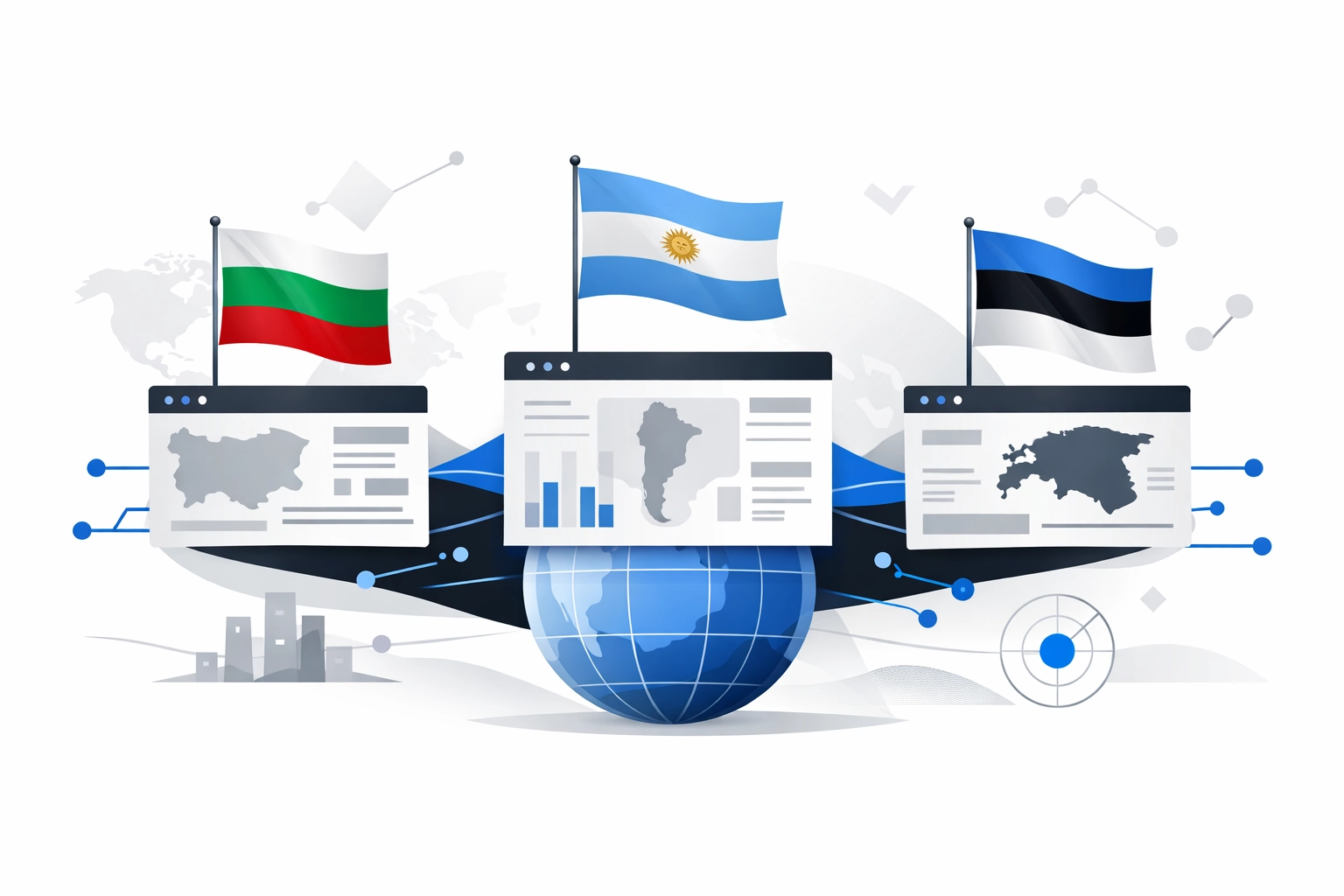
To illustrate how the governance framework plays out in practice, here are three country snapshots, focusing on how to source, validate, and operationalize lists for each ccTLD. The goal is not to memorize every domain, but to define a robust workflow that ensures quality data feeds localization and governance decisions.
Bulgaria: validating the Bulgarian ccTLD (.bg) for localization and risk mapping
The Bulgarian ccTLD is managed under .bg, and the IANA Root Zone entry confirms its delegation and registry details. When adding .bg to a country website list, validate against the registry’s rules and cross-check ownership data via the client RDAP/WHOIS database where privacy policies permit. This ensures you’re not inadvertently misclassifying a domain as Bulgarian if it’s registered elsewhere or reserved. For reference, see the IANA entry for .bg and the Bulgarian registry information. (iana.org)
Argentina: navigating .ar in a privacy-conscious era
Argentina’s .ar is operated by NIC Argentina, with the IANA root entry confirming its status as a country-code TLD. When compiling a Bulgaria-Argentina-Estonia inventory, ensure that .ar entries align with NIC Argentina’s governance and any locale-specific registration policies. Use RDAP/WHOIS data where permitted to verify ownership and avoid misattributing domains to the wrong market. The IANA entry for .ar is the authoritative pointer here. (en.wikipedia.org)
Estonia: Estonia’s .ee and governance considerations for localization
Estonia’s .ee is managed by Eesti Interneti Sihtasutus, and IANA’s root database confirms the delegation. For a localization program, .ee entries should be cross-checked against Estonia’s registry policies and regional internet foundation guidelines. Consistency with local regulatory expectations enhances trust and reduces the risk of misalignment between domain assets and market presence. See the IANA entry for .ee and Estonia’s national registry page for governance details. (iana.org)
Across these three cases, a recurring theme is that provenance and governance alignment trump guesswork. The IANA Root Zone Database provides the canonical reference, while RDAP-based data access supports privacy-conscious lookups that are more resilient to regulatory shifts. Incorporating these sources into your workflow helps prevent common misclassifications and data drift. (iana.org)
Expert insight and a common limitation to watch for
Expert insight: practitioners designing country-domain strategies emphasize a disciplined data-hygiene posture. A key takeaway is that country website lists should be treated as inputs to a broader localization and governance program, not as definitive market signals. This means implementing delta reports, checksum validations, and regular re-verification against the registry and authoritative RDAP sources. It’s also important to acknowledge a limit: even with robust provenance, country lists can still miss new registrations or reflect jurisdictions with restrictive disclosure policies, which means ongoing validation is essential.
Limitation/common mistake: assuming every listed domain in a country inventory represents a functional, market-facing asset. Some may be reserved, parked, or inactive, which can distort localization tests if treated as live signals. A proactive approach is to classify each domain’s status (active, parked, or redacted) and to document the rationale for its inclusion or exclusion.
Practical action plan: integrating country lists into localization workflows
To move from theory to practice, here is concise, action-oriented guidance you can apply immediately. It blends governance discipline with practical steps for Bulgaria, Argentina, and Estonia, while remaining adaptable to other ccTLDs.
- Step 1 — Source selection: start with the IANA Root Zone Database as the canonical reference for ccTLDs, and then pull registry-specific data for Bulgaria, Argentina, and Estonia to understand local governance. (iana.org)
- Step 2 — Provenance capture: record extraction date, source URL, and the extraction method (manual vs. automated). Include a note if data is filtered or augmented by a third party (and why).
- Step 3 — Quality gates: implement de-duplication, normalization (case, punycode), and status tagging (active/parked/redirect). Validate a subset of domains against the client’s RDAP/WHOIS database to confirm ownership where privacy policies permit.
- Step 4 — Privacy-conscious data handling: apply the RDAP-first approach where possible; preserve privacy by redacting or masking personal data in accordance with GDPR and registry policies. Document access controls and data retention policies. (ietf.org)
- Step 5 — Risk signal augmentation: layer in typosquatting risk indicators and brand-safety checks to identify domains that could pose reputational or security risks. Use DNS-intelligence-based signals to flag suspicious registrations and patterns. (dn.org)
- Step 6 — Localization planning with governance in mind: use the list to guide language, content, legal disclosures, and partner selections. Treat it as a governance input that informs testing, not a replacement for local-market due diligence.
For organizations actively using country lists to drive localization experiments, these steps help ensure data quality, regulatory alignment, and practical ROI. See the client resources for a reference point on RDAP/WHOIS data and related country inventories: RDAP & WHOIS Database, List of domains by Countries, and List of domains by TLDs. These can be useful sanity-check inputs as you build your own governance workflows.
Limitations and common mistakes (summary)
Even with a robust framework, several limitations persist. It’s crucial to anticipate and mitigate them rather than pretend they don’t exist:
- Data drift and incomplete coverage: country lists change as new registrations occur and older ones are deprecated. Regular refreshes are essential. The IANA Root Zone Database is the authoritative baseline, but it does not guarantee complete market coverage by itself. (iana.org)
- Privacy and regulatory constraints: GDPR-era privacy controls can redact or limit the visibility of personal data in RDAP/WHOIS responses. This requires a governance plan for how data is queried, stored, and shared. (european-union.europa.eu)
- Typosquatting and brand risk: even a high-quality list can be exploited by attackers. Augment bulk lists with DNS intelligence and machine-learning risk signals to detect suspicious patterns. (dn.org)
- Over-reliance on country lists as market signals: legitimate, active market domains may be interspersed with parked or test domains. Classification and lifecycle status should be part of the workflow.
- Variation across registries: country domains may have unique registration policies, geolocations, and dispute procedures. Always consult the national registry guidance in addition to the IANA entry. (iana.org)
Closing thoughts: a disciplined path toward localization and governance
Country website lists can power localization and governance when treated as a governance asset rather than a vanity dataset. The Bulgaria (.bg), Argentina (.ar), and Estonia (.ee) snapshots illustrate how to anchor your process in authoritative sources (IANA, registries) and privacy-aware data-access practices (RDAP). The result is a more accurate localization program, a clearer risk map, and a more auditable portfolio—one that stands up to regulatory scrutiny and brand scrutiny alike. As the ecosystem evolves, a deliberate approach to provenance, recursion checks, and privacy will remain essential. For teams tasked with global growth, the disciplined use of country lists is less about “more data” and more about “better governance.”
For readers who want to explore further, the client content provides concrete repositories and reference inventories you can adapt: the RDAP & WHOIS database, the country inventories, and the TLD lists. As a broader principle, country-focused data governance should accompany localization experiments, ensuring that every downloaded list translates into safer, more effective market entry and brand protection.