Governance-First Localization: A Practical Framework for Using Downloadable Country Website Lists (RO, MY, TW)
For brands expanding beyond their home markets, country-specific website visibility is a core asset. Yet the mere act of downloading a country-specific list of websites is not a strategy. Without governance, provenance checks, and ongoing hygiene, such lists quickly become liabilities—fragmenting brand signals, inviting security risks like typosquatting, and triggering regulatory concerns around data usage. This article offers a rigorous, governance-centered approach to using downloadable country website lists, with concrete guidance for Romania (RO), Malaysia (MY), and Taiwan (TW). We balance practical steps with a critical eye toward data quality and risk, and we show how a disciplined framework can support localization, compliance, and brand safety across markets.
Context matters. International SEO and localization rely on signals we can influence—domain structure, geotargeting signals, and content alignment. Google’s guidance on managing multi-regional and multilingual sites emphasizes that signals such as country-targeted domains or subdirectories must be used thoughtfully to avoid confusing search engines or users. A governance-first workflow helps ensure that country lists are a reliable input, not a brittle artifact. (developers.google.com)
Beyond visibility, the governance lens reveals a set of practices that protect your brand as you scale: data provenance and lineage, privacy considerations, ongoing data hygiene, and explicit ownership. When you apply these principles to RO, MY, and TW lists—and to the accompanying localization plans—you create a repeatable playbook that scales with your portfolio. A practical starting point is to understand where country data comes from, how it’s maintained, and how it should interact with your content and technical architecture.
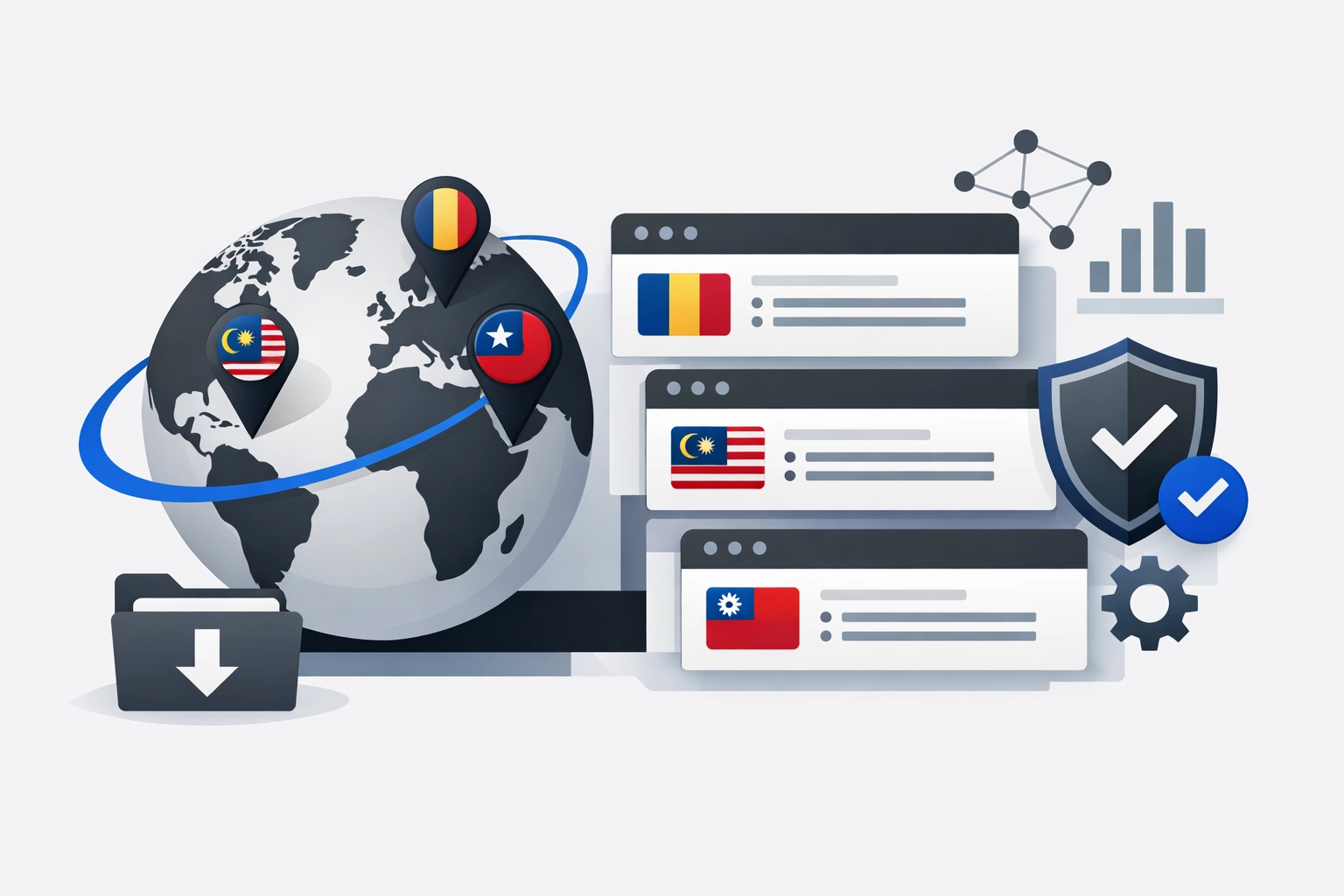
To ground the discussion, consider three commonly requested inputs in the domain community: (1) Download list of Romania (RO) websites, (2) Download list of Malaysia (MY) websites, and (3) Download list of Taiwan (TW) websites. These inputs can inform local outreach, partner discovery, content localization, and risk mapping—provided you treat them as data assets with clear provenance and governance.
A framework for safe, scalable use of country lists
Below is a five-part framework designed to turn downloadable country lists into a responsible component of localization and brand governance. Each step includes concrete actions, examples, and cautions drawn from domain-data best practices and a governance mindset.
Step 1 — Define the objective and audience signals
Begin with a precise objective: what problem are you solving with a RO/MY/TW list? Are you identifying potential local partners, benchmarking local digital ecosystems, or mapping content localization gaps? Align the input data to the business objective and to publisher-friendly topics. Importantly, differentiate inputs (the lists) from outputs (your localization plans, partner outreach templates, or content localization roadmaps). A clear objective reduces scope creep and improves the quality of downstream analysis.
Expert insight: governance-focused teams emphasize starting with the question, “What decision will this data enable?” If the answer is not directly about localization decisions or risk management, reconsider the input’s role in your workflow.
Step 2 — Validate provenance and scope of the data
Provenance matters. When you download country lists, you should document the source, the data fields included (domains, DNS records, hosting country, SSL status, etc.), and any transformation applied during ingestion. RDAP-based data offers machine-readable, structured registration data that can improve reliability over plain text lists. The transition from WHOIS to RDAP is underway in many registries and registrars, offering better privacy and data quality controls for automated workflows. (ietf.org)
For localization, provenance also means validating that the list corresponds to the targeted market geography. In practice, this means cross-checking a RO list against Romania-facing registries and verifying that listed domains actually serve Romanian users or businesses. Google’s multi-regional site guidance reinforces that geotargeting signals should be accurate and meaningful to users in the country you intend to reach. (developers.google.com)
Step 3 — apply data hygiene and risk screening
Any downloadable list is only as good as its hygiene. Deduplication, normalization (consistent domain casing, removal of trailing slashes and wildcards), and validation against live DNS data are essential. A key risk area is typosquatting—errors or deliberate typos that create domains with similar spellings to trusted brands. Typosquatting remains a real threat in the wild, with evidence that such domains can host phishing or malware, or simply defraud users who mistype a brand name. Incorporating a typosquatting screen into your workflow helps you pre-empt reputational damage and protects your localization efforts. (huntress.com)
Step 4 — normalize, enrich, and map to localization outputs
Normalization turns raw lists into actionable inputs. Normalize on fields such as domain, country, registrar, and DNSSEC status. Enrich with domain-age, TLS/SSL status, and hosting-region signals to gauge local trust signals. Then map each item to localization outputs: targeted landing pages, regional content variations, and partner outreach templates. The goal is to produce a clean, auditable input for localization squads, not a static directory that decays the moment a page is de-listed.
Step 5 — govern, review, and update
Governance is not a one-off event; it’s an ongoing discipline. Assign ownership for each data source, document update cadences, and implement checks to detect drift or data quality degradation. In practice, you’ll want a quarterly review of RO, MY, and TW lists, with a monthly sanity check of critical domains that drive localization or risk signals. Governance also means privacy-aware handling: minimize personal data collection when evaluating lists and ensure compliance with applicable laws and best practices in data management.
Operationalizing the framework for RO, MY, and TW
Let’s translate the framework into practical actions you can take when working with the three audiences in question. The examples below show how a fictional brand can leverage downloadable country lists to inform localization and risk management without sacrificing governance or safety.
Romania (RO) — local partner discovery and content alignment
The Romanian digital ecosystem features a mix of local tech players, agencies, and consumer sites. A RO-focused list can help identify potential local partners, content distributors, and media outlets for localization programs. Start by downloading the Romania-specific list and running a hygiene pass to remove duplicates and obviously irrelevant domains. Then enrich the data with DNS and TLS information to estimate local trust signals. Finally, map high-potential domains to Romanian landing pages and Romanian-language content variants, aligning outreach templates with each partner’s local footprint. For direct access to RO resources, you can consult the Romanian-domain inventory page and related country-specific resources. Download Romania sites for a starting point.
Malaysia (MY) — market signals and compliance considerations
Malaysia presents a dynamic, bilingual market where content in Malay and English often coexists. A MY-focused list supports market signal mapping—identifying local publishers, review sites, and consumer portals that resonate with Malaysian audiences. Hygiene and validation remain critical: typosquatting risk exists across markets and can undermine trust if misused in localized campaigns. The governance lens also asks questions like: Are these sites compliant with local privacy expectations? Do they provide clear contact channels? A robust workflow ties the MY list to regionally appropriate content, product messaging, and outreach strategies. For direct access to MY resources, consult the country list page and related domains catalog at the client site.
Taiwan (TW) — audience signals and brand trust
Taiwan’s digital landscape features unique language and cultural cues that require careful localization. A TW website list can illuminate key local publishers, tech blogs, and consumer portals that influence awareness and conversion. A governance-first approach helps ensure that the TW list remains current and that any additions or removals are tracked over time. When mapping to TW content, prioritize local-language pages and ensure that geotargeting signals in your site structure align with the TW audience’s expectations. Access to TW resources may be cross-referenced with the broader country catalog hosted by the client. For TW-specific guidance, see the country inventory pages and related resources.
Insights, limitations, and common mistakes
Expert insight: Data provenance and governance matter more than ever in 2026. When you treat country lists as data assets with lineage, you can explain decisions to stakeholders, justify localization investments, and reduce risk across global campaigns. The real value emerges when governance interfaces with your localization plan, not when lists sit on a shared drive as a static casualty of a quarterly update.
That said, the approach has limits. A downloadable list is only a snapshot of a living ecosystem; it can’t capture every changing partnership, domain migration, or platform shift. Lists can also be outdated if update cadences aren’t strict. Relying solely on lists for localization decisions can lead to misaligned content, broken links, or missed regulatory nuances. A robust program pairs lists with ongoing domain hygiene checks, direct validation with local teams, and a clear process for handling changes.
In practice, many teams fall into two common traps: (1) treating the list as exhaustive or authoritative without independent verification, and (2) neglecting the privacy and compliance implications of using third-party domain data. A governance framework mitigates these risks by enforcing provenance checks, data minimization, and auditable update trails. The RDAP movement (replacing WHOIS in many registries) offers improved data quality, privacy features, and machine-readability that support scalable workflows, especially when you run domain asset discovery at scale. (ietf.org)
Expert insight and best practices
One practitioner’s takeaway: treat country lists as living data assets. Build an auditable data lineage, attach owners for updates, and ensure your localization outputs are tightly coupled to current, validated inputs. By integrating governance into every step—from data intake to final content localization—you reduce risk, improve trust, and create a scalable framework that serves both beginners and professionals in the domain space.
Limitations and actionable mistakes to avoid
- Assuming lists are complete or evergreen. Domains shift ownership, hosting changes, and sites go offline; schedule regular refreshes and cross-checks.
- Ignoring data privacy and regulatory constraints. Even non-personal domain data can raise privacy concerns depending on jurisdiction and use case; apply data-minimization principles and document purposes.
- Over-reliance on a single data source. Combine RDAP-derived signals with independent checks (e.g., DNS health, SSL status) and local-market validation to avoid blind spots.
- Underestimating typosquatting risk. Implement a typosquatting screening step to prevent misdirection and brand damage in localized campaigns.
- Misalignment between data and localization outputs. Ensure every listed domain maps to actionable content or outreach plans rather than existing purely as an archival artifact.
Putting it into practice: a quick checklist
- Document source and data fields for RO, MY, and TW lists.
- Run a hygiene pass: deduplicate and normalize domains.
- Screen for typosquatting and potentially malicious domains.
- Enrich with DNS, TLS, and hosting signals where relevant.
- Map domains to localization outputs and regional content plans.
- Assign data owners and establish cadence for updates.
Conclusion
Downloadable country website lists can be a powerful input for localization, partner discovery, and market intelligence when embedded in a governance-first framework. By focusing on provenance, data hygiene, and ongoing oversight, brands can turn RO, MY, and TW lists into reliable, auditable inputs that support localization strategies, risk management, and compliant growth. The key is to treat these lists as data assets with clear ownership, update cycles, and explicit integration into the broader localization and brand governance program.
For a practical starting point on RO, MY, and TW resources and to connect these concepts to a real-world product portfolio, explore the client’s country pages and RDAP database resources, which offer structured data and governance-ready inputs for domain strategy. Download Romania sites and explore related country pages for a broader, governance-aligned view.