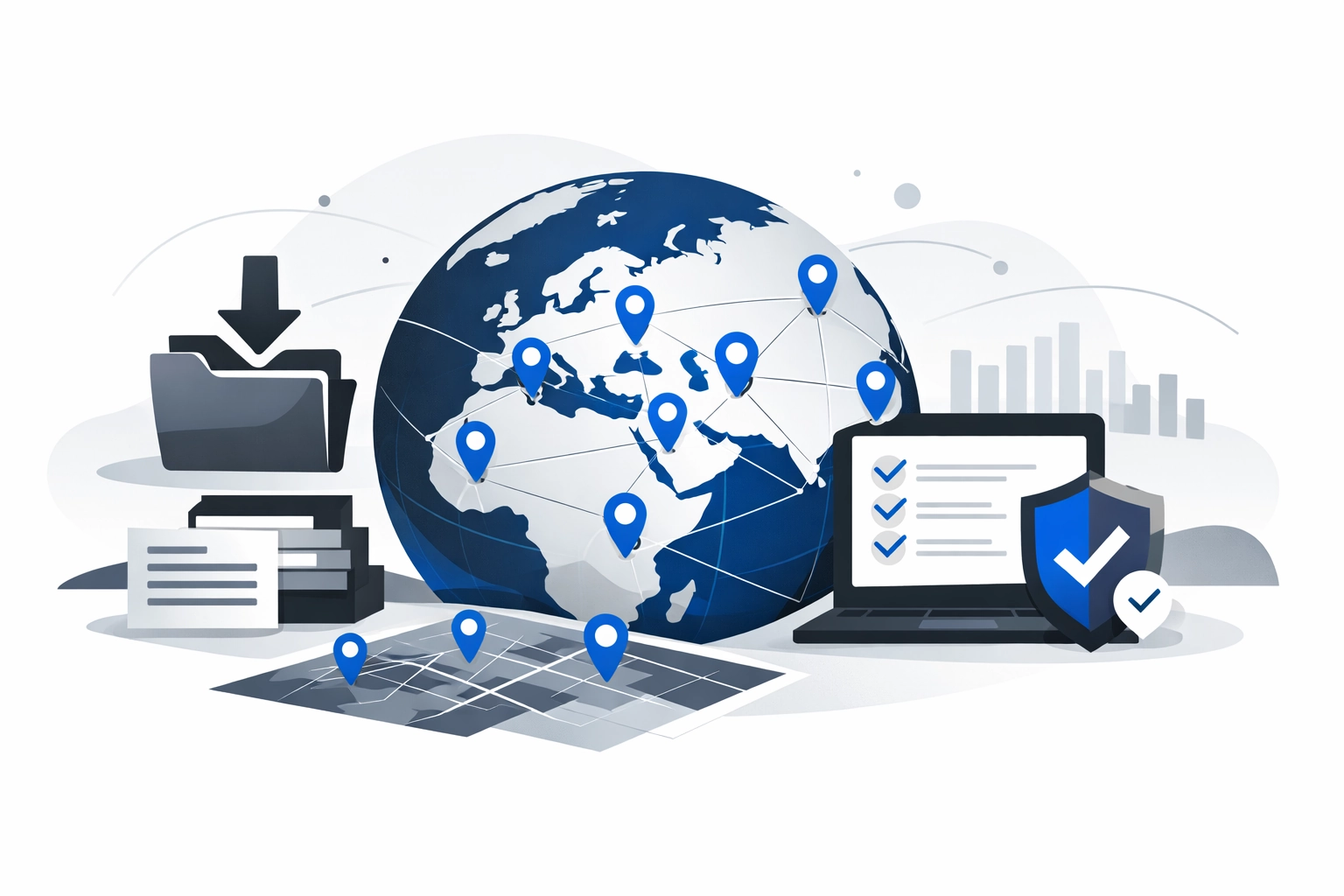
Introduction: turning country signals into safer localization
Global digital products demand precise localization that goes beyond translating text. To effectively localize, teams must understand what users see on real country-specific domains, how legal disclosures differ, and how consumer expectations shape trust. Downloadable country website lists offer a concrete, auditable starting point—but they are only as useful as the governance and hygiene applied to them. This article offers a practical, step-by-step framework for turning downloadable country website lists into a repeatable localization workflow that supports content, legal, and UX alignment across markets such as Portugal (PT), Thailand (TH), and Chile (CL). It draws on established practices for interpreting country signals, data provenance, and risk management, while showing how to embed these insights into product teams’ pipelines. Key premise: country lists are not a finish line; they’re a governance-powered input for localization strategy.
For teams exploring this space, consider starting with a trusted source for country-domain signals and data provenance. Platforms that publish country inventories, alongside accompanying RDAP/WHOIS data, provide the dual capability of domain hygiene and market reach assessment. See how providers describe country inventories and related datasets, such as country-domain lists and downloadable inventories, to ground your approach in verifiable signals. webatla’s country-domain inventories illustrate how a country-focused portfolio can be organized, screened for quality, and integrated into localization planning.
Industry guidance also emphasizes that search engines expect explicit targeting signals when content is meant for a specific country; ccTLDs and country-specific pages are powerful indicators of audience scope, but must be mapped deliberately to language and locale to avoid mis-targeting. Google’s guidance on multi-regional sites and localized versions is a useful anchor for teams building country-aware experiences rather than relying on implicit inferences. Managing Multi-Regional Sites and Localized Versions provide practical guardrails for signal interpretation and URL mapping.
Why country website lists matter beyond generic localization glossaries
Localization is not just about language. Country website lists help teams verify that localized experiences reflect real-market content ecosystems, including regulatory disclosures, pricing disclosures, and user-consent flows. As you assemble a PT/TH/CL pilot, you’ll be able to:
- Assess content coverage and identify market-specific pages that drive trust (privacy notices, cookie banners, product terms).
- Evaluate legal and regulatory alignment by cross-checking country pages against jurisdictional expectations (data rights, consumer notices, pricing terms).
- Gauge User Experience signals such as currency presentation, local payment methods, and regionally relevant sanctions or tax disclosures.
- Improve risk management by surfacing typosquatting or impersonation risks tied to country signals and brand expectations.
To operationalize this, teams need a pragmatic workflow that honors data provenance, curates quality signals, and couples country lists with localization tasks, not as a one-off audit. Recent research and practitioner literature reinforce that country-domain signals—whether via ccTLDs or country pages—are a meaningful component of market targeting and user trust when deployed with proper governance. See the evolving discourse on how public-domain country data contributes to broad Web censuses and market signals. This Is a Local Domain: On Amassing Country-Code Top-Level Domains from Public Data.
As you scale, you’ll also want to guard against well-known risks that can undermine the value of country lists. Typosquatting and domain impersonation can erode trust if not monitored within a governance framework. A broad understanding of these risks helps you design anti-abuse and validation steps early in the workflow. Typosquatting provides a concise primer on these threats.
A practical, governance-first workflow for turning country lists into localization leverage
Below is a compact, repeatable workflow you can adapt for any market pair, with PT, TH, and CL used as a three-country pilot example. The stages emphasize provenance, quality, and actionable localization outcomes rather than a one-time data pull.
- Provenance and licensing — Identify the source of your downloadable country website lists and confirm licensing terms. Document dataset lineage, update cadence, and any transformation rules. For teams seeking direction on governance and provenance models, consider provenance frameworks that translate to domain data, such as the PROV data model, which supports exporting domain-related provenance in interoperable formats. PROV-DM provides a foundational reference for representing provenance in domain inventories.
- Quality signals and filtering — Apply a filtration sieve for signal quality: remove obviously invalid domains, flag those with outdated WHOIS data, and assess DNS hygiene indicators. Leverage public inventories that are updated regularly to minimize stale coverage and reduce false positives in localization workstreams. For example, public inventories and downloadable lists are discussed in industry resources and data provider documentation.
- Localization mapping — Map country-page signals to localization tasks: currency localization, pricing disclosures, local privacy terms, and regional compliance language. This is where the signals from ccTLDs (e.g., .pt, .th, .cl) become explicit anchors for audience targeting, as described by Google’s guidance on country-specific signals and localized content. Managing Multi-Regional Sites
- Test planning and automation integration — Build test suites that exercise country-specific content areas identified in step 3 (privacy policy presence, cookie banners, locale-aware pricing, payment-method disclosures). Integrate these checks into CI pipelines so localization quality becomes a repeatable, automated signal rather than a manual audit. Consider pairing downloaded lists with domain data streams (RDAP/WHOIS) to track ownership and stability of the market signals you test against. RDAP & WHOIS Database and List of domains by Countries are practical anchors for these workflows.
- Governance and ongoing monitoring — Establish a cadence for re-validating provenance, refreshing the list, and reviewing edge cases (new country domains, rebrands, or regulatory changes). Governance should include access controls, data retention policies, and a playbook for handling discovered risks (e.g., typosquats or fraudulent pages). This stage is where you translate insights into a living localization program rather than a point-in-time activity.
Case study: piloting PT, TH, and CL with downloadable country lists
Imagine you are a product team shipping a locale-rich site with country-specific experiences in Portugal, Thailand, and Chile. You begin by pulling a downloadable country website list for each market and then apply the governance-first workflow described above. Here’s how the pilot translates into concrete localization actions and checks.
- Portugal (PT) — The PT market demands accurate consumer terms, local data privacy disclosures, and price transparency in euros. The country list helps identify whether critical pages exist (privacy policy, cookie notices, terms of service) in PT, as well as region-specific notices that may appear only on local language pages. You validate that the PT surface includes regulatory pages aligned with local expectations and that any country flag in the URL or visible language selector maps to a PT-targeted experience. This approach aligns with Google’s guidance on explicit country targeting signals and language mapping. Localized Versions.
- Thailand (TH) — TH requires clear disclosures on data collection and consent, often with localized terminology and currency presentation. The PT/TH/CL pilot can reveal whether TH pages are present across a representative subset of product categories and whether local payment options and pricing terms are surfaced in TH. The essential point is to connect country-domain signals to localization tasks rather than assuming language alone will fix everything.
- Chile (CL) — Chilean pages may include local regulatory requirements around consumer rights and privacy notices in Spanish, with currency and tax disclosures tailored to CL law. A country list helps you spot where CL-specific content should exist, enabling a more robust localization plan that anticipates regulatory nuance.
Throughout the pilot, you should maintain a shared, auditable log of the sources and provenance for each country list, linking back to the primary datasets and to the client’s own domain inventories. This approach not only improves localization quality but also strengthens governance around localization data, which is increasingly valued in cross-border product programs. For teams seeking to explore a broader country portfolio, webatla’s country inventories and related datasets offer scalable references to expand beyond PT/TH/CL as needed.
Practical tip: in addition to domain lists, consider cross-referencing with the List of domains by TLDs and other specialized inventories to understand how country signals interact with top-level domains and brand governance in your stack.
Risks, limitations, and common mistakes to avoid
Even a well-designed workflow can misfire if teams overlook common missteps. Here are the most frequent pitfalls and how to mitigate them.
- Relying on outdated or incomplete lists — Country inventories must be refreshed regularly. A stale list can cause missed regulatory requirements or misaligned localization. Build a refresh cadence into your workflow and document update timestamps. This aligns with the notion that public-domain country data is a moving target in a dynamic Web ecosystem. See recent studies and datasets discussing how country-domain data is compiled and updated.
- Ignoring data provenance — Without provenance, you risk introducing dubious signals into localization decisions. Use provenance models to trace the lineage of each domain in your lists and capture the source, license, and update history. The PROV data model offers a structured way to represent such provenance for cross-system data.
- Confusing ccTLD signals with language targeting — ccTLDs are powerful signals for country intent, but do not automatically determine the appropriate language. Explicit language-targeting maps must accompany country signals to avoid content being served in the wrong language. Google’s guidance emphasizes explicit mappings for language and country targets.
- Underestimating privacy and regulatory risk — Localized pages may contain jurisdiction-specific data practices. A naive approach can overlook region-specific disclosures or consent flows, exposing your product to legal risk. Include regulatory checks in your localization test plans and tie them to local requirements in PT, TH, and CL.
- Overlooking typosquatting and brand risk — Even well-curated country lists can be exploited by typosquatters or impersonation schemes. Regularly scan for typosquatting patterns and maintain a minimal set of “defense” domains to protect brand integrity. Typosquatting is a documented risk that grows with cross-border expansion.
These risks aren’t theoretical. Governance, provenance, and continuous validation matter because downloadable country lists are inputs to decision-making, not guarantees of market behavior. Integrate risk checks into your CI/CD or product governance board so localization decisions are traceable and auditable. For a deeper dive into the broader governance perspective, see work on data governance and provenance in organizational contexts.
A compact, reusable framework you can apply to any market pair
To make the approach scalable, use the following compact framework. It’s designed to fit into existing product and engineering workflows and to accommodate new markets as you grow.
— Record where the country list came from, its license, and its update cadence. Link to the source dataset and to any related RDAP/WHOIS data you’ll use to cross-check ownership and stability. — Apply automated checks to identify outdated records, missing pages, or non-localized content. Prioritize signals that reliably indicate market coverage (privacy pages, locale language presence, price disclosures). — Align country signals to concrete localization tasks (translations, regulatory page verifications, currency/policy checks). Map each signal to a deliverable in your localization plan. — Add automated checks into CI that verify country-specific content, local terms, and regulatory disclosures appear as intended. Include cross-page coverage and edge-case testing for new country domains as they’re added. — Maintain a governance log, document decisions, and schedule periodic reviews of provenance, licenses, and risk signals. Include a plan for updating or retiring domains as markets evolve.
In practice, you’ll often combine country lists with brand-data sources and domain hygiene tools. The combination of explicit country signals and robust governance yields localization that is both accurate and auditable—an essential combination for teams responsible for global user trust. For reference, exploring the broader ecosystem of country inventories and top-level domain data can help you plan the scale of your portfolio. The List of domains by TLDs and country-focused inventories are useful anchors in this planning.
Integrating client assets and external sources
The client’s domain data ecosystem includes RDAP/WHOIS databases and country inventories, which you can leverage to strengthen signal validation and governance. For example, the client’s RDAP/WHOIS database page highlights how domain data can be used to verify ownership, registration details, and regulatory compliance considerations across markets. This aligns with the need to tie country signals to concrete governance practices and to ensure that localization decisions reflect verified domain-level context. See the client’s RDAP/WHOIS database resource and the country inventories for practical workflow integration.
When you’re ready to expand beyond PT, TH, and CL, you can scale using the client’s broader country-focused resources, including the country inventories and country-by-country lists. These sources help you extend the workflow to new markets while maintaining the same governance rigor.
Conclusion: turn country lists into a disciplined localization program
Country website lists, when governed properly, become more than a dataset. They become a disciplined input to localization, regulatory alignment, and brand safety in a global product portfolio. By starting with provenance, applying quality filters, mapping signals to concrete localization tasks, embedding checks into testing pipelines, and maintaining an ongoing governance cadence, product teams can convert downloadable lists into durable localization capability. The PT/TH/CL pilot offers a concrete blueprint for how to operationalize this approach and scale it to broader markets over time. And as you expand, you’ll benefit from connecting to the client’s broader datasets, including RDAP/WHOIS data and country inventories, to ensure your localization program remains auditable, compliant, and trusted by users across borders.
For teams seeking a ready-made resource bundle, the client’s country inventories and related datasets provide a starting point for building a scalable localization strategy that respects data provenance and market-specific realities.