Problem-driven introduction: bulk domain lists are easy to download, hard to govern
For organizations building or maintaining a brand portfolio, bulk domain lists offer a tempting shortcut: a quick snapshot of potential domain assets across extensions, regions, and niches. Yet the very convenience of a downloadable list can mask a spectrum of governance challenges—data quality, privacy constraints, and the operational friction of turning raw lists into actionable decisions. The shift from WHOIS to the modern RDAP framework amplifies these concerns, because the data you download is increasingly structured, access-controlled, and contextualized rather than plain text. In 2025 ICANN and registries moved toward RDAP as the standard for registration data, replacing the traditional port-43 WHOIS in many gTLDs. That transition matters for how you validate, enrich, and act on bulk lists. RDAP delivers machine-readable data, better privacy controls, and standardized objects for domains, entities, and nameservers, which has meaningful implications for portfolio governance.
In practice, many teams struggle with a simple paradox: the data you can download quickly becomes a maintenance headache unless you apply a deliberate design to how you validate, enrich, and govern it. This article presents a practical, practitioner-focused framework to turn downloadable domain lists—whether you’re after a download list of .us domains, download list of .vip domains, or a download list of .sbs domains—into a trustworthy component of brand risk management, not a source of blind risk.
While the topic sits at the intersection of data quality, governance, and security, the goal here is concrete: provide a field-tested approach that beginners can start with and professionals can scale. We’ll ground the discussion in current industry practice and point to relevant external standards and sources where appropriate.
What makes downloadable domain lists risky (and worth fixing)
Bulk domain lists can be valuable for discovery, competitive benchmarking, or portfolio planning, but they carry several non-trivial risks if not handled properly:
- Duplications and inconsistencies: The same domain appearing in multiple downloads, divergent naming conventions, or inconsistent date stamps create a false sense of coverage or, worse, blind spots in governance.
- Privacy and data-protection constraints: The data you fetch may be subject to redactions or access controls. RDAP opens the door to structured data, but it also enforces policy-based access that you must respect to stay compliant.
- Data provenance and traceability: Without a provenance trail, you can’t easily verify where a domain came from, when it was collected, or how it’s been transformed—critical for audits and risk reporting.
- Quality vs. actionability: A raw dump lacks enrichment (whois/registrant status, DNS health, hosting risk, and brand-usage signals), making it hard to translate into concrete decisions.
Expert practitioners increasingly treat data provenance and governance as the backbone of any domain strategy. As RDAP adoption solidifies, the ability to trace data lineage, enforce access controls, and integrate with internal systems becomes not a nicety but a necessity. This is especially true when you’re working with lists tied to .us, .vip, or .sbs extensions, which have particular regulatory and market considerations in the U.S. and beyond. For the governance-minded professional, bulk lists are only as reliable as their documentation and their integration into a controlled workflow.
The diagnostic framework: Discover, Validate, Enrich, Govern, Act
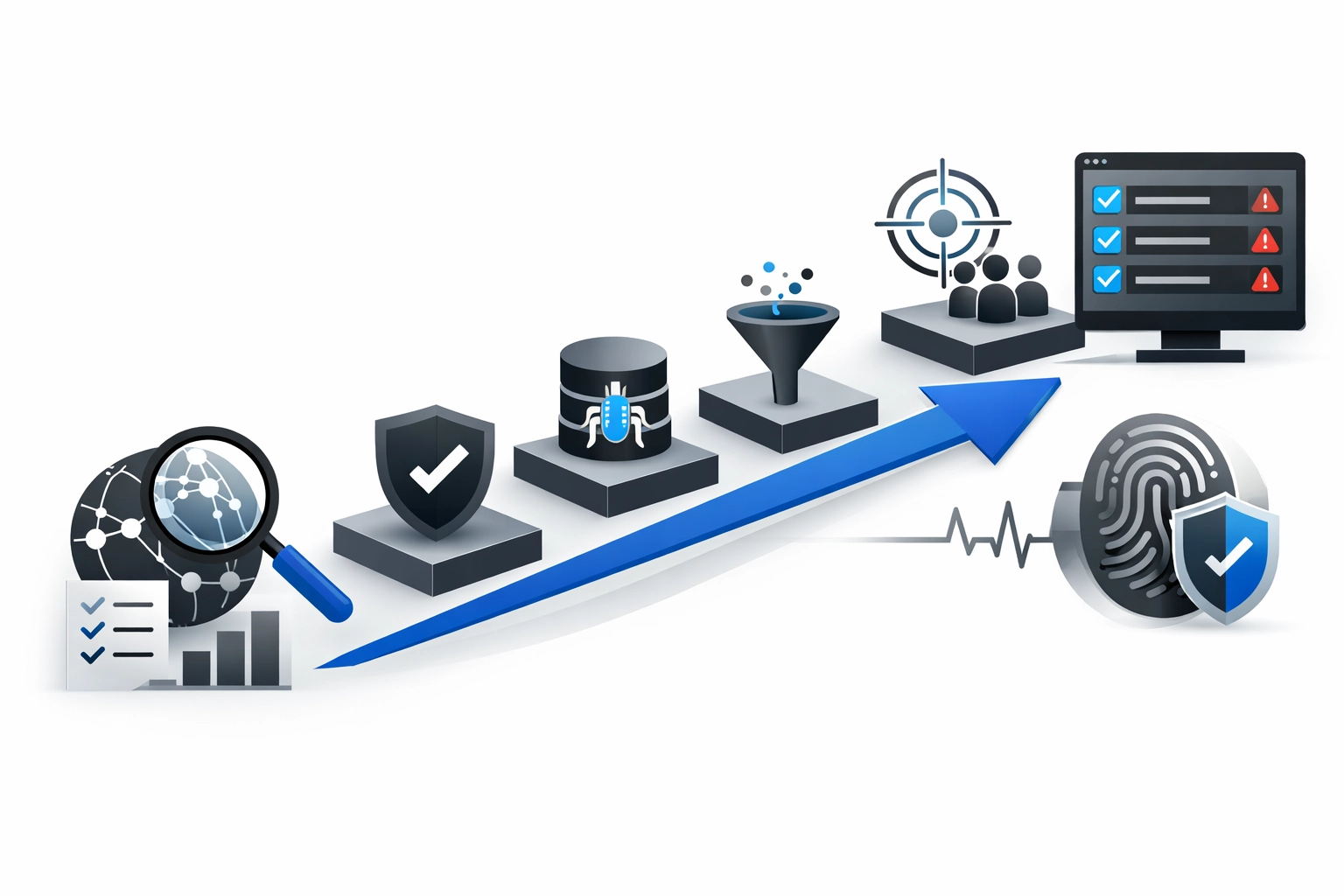
To transform a bulk domain list into a governance-ready asset, apply a five-stage framework that intentionally blends people, process, and technology. Each phase builds a verifiable audit trail, supports scalable ops, and aligns with current data-access standards such as RDAP. The five stages are:
- Discover — map sources, capture metadata, and establish initial quality rules.
- Validate — apply deterministic checks, deduplicate, and verify data against authoritative signals.
- Enrich — augment with ownership, DNS health, and brand-usage indicators.
- Govern — implement governance policies, provenance records, and access controls; automate compliance checks.
- Act — translate validated data into decisions and actions (risk flags, domain requests, or portfolio adjustments).
The framework below translates each stage into practical steps you can adopt today. It is designed to accommodate ongoing inputs (new downloads, updated lists) and to scale as your portfolio and regulatory requirements evolve.
1) Discover: source mapping and baseline quality rules
Begin with a clear map of where bulk domain lists originate and how often you refresh them. Typical sources include dedicated pages that present list downloads by TLD or geography, such as a US TLD list, a general “List of domains by TLDs” hub, or country-focused compilations. Establish baseline metadata for each source: download date, source URL, scope (gTLDs vs ccTLDs), coverage (complete vs partial), and known data limitations. Define a minimal quality rule set (e.g., deduplicate, normalize case, canonicalize punycode, and flag redacted fields). In the RDAP era, you’ll also record whether a source provides full domain objects or redacted records, which informs later validation steps. ICANN’s RDAP guidance emphasizes standardized, machine-readable data and the shift away from legacy WHOIS practices. (icann.org)
2) Validate: cleanse, deduplicate, and verify against signals
Validation is the workhorse of quality. It includes:
- Deduplication and normalization: Normalize case, hyphenation, and punycode; collapse equivalent representations to a single canonical form.
- Field validity checks: Ensure domains look syntactically valid, dates are logical, and DNS records (as available) resolve in expected ways.
- Provenance verification: Confirm that the domain appears in the intended source with a recent timestamp; flag stale entries for manual review.
- RDAP-aware checks: When RDAP data is available, verify structures (domain object, entity object, nameserver object) and respect access controls that may redact sensitive fields. This is an important shift from legacy WHOIS expectations. (icann.org)
Practical tip: maintain a blacklist of common error types (e.g., misformatted domains, parked domains, or domains with invalid registrant data) so your teams can focus on genuine signals. A well-maintained deduplication routine also reduces confusion when you compare multiple bulk downloads (for example, a download list of .us domains against a download list of .vip domains to identify cross-extension branding opportunities or risks).
3) Enrich: add governance-ready context
Raw lists gain value when enriched with signals that matter for decision making. Consider the following as standard enrichment blocks:
- Registrant or organization signals: Ownership hints, affiliation, or branding notes that help assess risk or opportunity.
- DNS health indicators: Nameserver diversity, uptime, and DNSSEC status can flag risky or compromised configurations.
- Brand-usage signals: Indicators of active brand usage versus cybersquatting risk; cross-check against your internal brand taxonomy.
- Geographic and regulatory context: Align domains with country-specific branding and legal considerations (especially when dealing with lists tied to country codes like .us or regional extensions).
Enrichment creates a bridge to action. It also makes it feasible to implement governance rules, such as auto-suppressing entries that fail key health checks or requiring manual review for high-risk domains tied to core brand assets.
4) Govern: provenance, access, and policy-driven controls
Governance is where policy, process, and people converge. Core components include:
- Provenance records: Document the lineage of each domain within a list (source, date captured, enrichment steps, and any transformations).
- Access controls and privacy compliance: Ensure that bulk-domain workflows respect data-access policies, including RDAP’s authenticated access where applicable. This is increasingly central to compliance programs. ICANN’s RDAP framework is designed to support structured, policy-aware data access. (icann.org)
- Governance dashboards: Build a portfolio view that highlights risk posture, data quality metrics, and compliance status across sources and TLDs. This makes it possible to report to stakeholders with auditable evidence.
- Change management: Treat each bulk download as a transient snapshot that must be reconciled with the live registry data on a defined cadence.
In practice, governance isn’t about slowing teams down—it's about ensuring that decisions (e.g., which domains to acquire, protect, or deprecate) are based on reliable, traceable data rather than noisy spreadsheets.
5) Act: translate quality into portfolio decisions
The final phase is where governance yields tangible outcomes. Actionable steps include:
- Risk flags and remediation plans: Route flagged domains to risk owners with clear remediation steps (e.g., monitoring, mark-as-owned, or deprecate).
- Portfolio optimization: Use enrichment signals to identify domains that reinforce brand protection or marketing strategies, while pruning underperforming or high-risk assets.
- Documentation for audits: Produce verifiable reports that tie decisions to provenance trails and data-quality metrics.
Put differently: the quality framework turns downloadable lists into a governance-ready service that informs brand strategy, risk management, and compliance posture rather than simply expanding your backlog of domains to evaluate.
Concrete example: applying the framework to US, VIP, and SBS lists
Suppose your team routinely downloads three kinds of lists: a download list of .us domains, a download list of .vip domains, and a download list of .sbs domains. How do you apply the five-phase framework to these sources in parallel while maintaining coherence across the portfolio?
- Discover: catalog the three sources, capture download timestamps, and note any source-specific fields (e.g., registrant status, DNS health, or branding cues). If you’re combining these lists into a single dashboard, ensure you maintain a source identifier per entry.
- Validate: run deduplication across all three sources, normalize domain representations, and verify that domains resolve to a live DNS record where feasible. Use RDAP to fetch structured domain objects for cross-validation when available. ICANN’s RDAP guidance emphasizes standardized data structures to support reliable processing. (icann.org)
- Enrich: append ownership signals, brand-alignment indicators, and DNS health metrics for each domain. For high-priority assets, add a “brand-risk score” that factors in proximity to core trademarks or product lines.
- Govern: maintain provenance for each entry, enforce access controls on sensitive fields, and document the rules that determine when a domain is considered “high risk” or “high value.”
- Act: deliver an executive-ready risk report, plus a tactical remediation list for portfolio owners. The actions grounded in the framework should be auditable and repeatable across refresh cycles.
This approach helps organizations treat bulk downloads not as static dumps but as components of an ongoing governance program. In the real world, the effectiveness of this workflow hinges on integrating data provenance and RDAP-compliant signals into your internal systems—so you can answer questions like “which domains in the US list are high-risk and require monitoring?” with confidence.
Expert insights and common mistakes
Expert practitioners in governance and brand protection emphasize two points. First, data provenance is not optional. Without a traceable lineage, you cannot prove how a decision was made or defend it in an audit. Second, a common mistake is treating downloadable lists as finished products. They are inputs to a governance process that must be refreshed and reconciled against live registry data. The RDAP transition reinforced this need for structured, auditable data flows. For those who want a practical reference, ICANN’s RDAP materials describe the standardized data objects and the rationale for the new protocol. (icann.org)
Practical limitation: bulk lists often lag reality. Registrations change between download moments, and redactions in RDAP can obscure certain fields. The remedy is to embed robust provenance, schedule regular refreshes, and maintain a policy-driven approach to redacted fields. The net effect is a governance model that accepts data imperfections but compensates with process discipline and auditable controls.
Limitations and potential pitfalls you should plan for
- Data latency: Registry data shifts between downloads; expect a window of staleness and build refresh cadence into your workflow.
- Redacted fields and privacy controls: RDAP may redact sensitive fields; design your enrichment and decision rules to handle partial data gracefully.
- Cross-source reconciliation: Different sources may have different coverage or formats; robust deduplication and canonicalization are essential.
- Tooling complexity: Implementing provenance and access controls can be technically challenging; start small with a defensible core and scale thoughtfully.
Despite these limitations, the payoffs are significant: a governable, auditable, and scalable framework that makes bulk domain lists an asset rather than a liability. The RDAP transition is a catalyst for these improvements, not a hurdle to overcome in isolation. (icann.org)
Practical checklist: getting started this quarter
- Map sources: List all bulk download sources you rely on (including US TLDs and other domain hubs).
- Define baseline quality rules: Deduplication, normalization, and provenance capture are the non-negotiables.
- Choose enrichment signals: DNS health, ownership cues, and brand alignment indicators.
- Implement governance controls: Provenance records, access controls, and a change-management process.
- Automate reporting: Develop dashboards that show data quality, provenance, and risk posture across sources.
- Plan for RDAP: Ensure your workflow accommodates RDAP data structures and access rules, especially when pulling data from gTLDs that migrated from WHOIS to RDAP. (icann.org)
Conclusion: turning bulk lists into governance-ready assets
Downloading a bulk list of domains—whether a download list of .us domains, a download list of .vip domains, or a download list of .sbs domains—is not a finished product. It is a raw material that, with the right design, becomes a controlled, auditable input for brand governance. The five-stage framework—Discover, Validate, Enrich, Govern, Act—offers a practical roadmap that aligns with modern data-access standards (RDAP) and the realities of dynamic portfolios. It helps beginners understand the lifecycle of bulk-domain data and gives professionals a scalable pattern for building governance dashboards, risk reports, and action-oriented workflows.
Where to start your implementation? Consider a lightweight pilot using one source and a limited set of signals, then extend to additional sources and richer enrichment as you establish governance baselines. The goal is not perfection in the first pass, but measurable gains in data provenance, consistency, and decision quality across your portfolio.
Internal and external sources cited
The framework and RDAP context draw on authoritative industry standards and recent shifts in domain data access policies. RDAP replaces port 43 WHOIS for many generic TLDs, delivering structured, JSON-based domain data and enabling policy-aware access. ICANN’s RDAP materials describe the data objects and rationale behind the transition. For practitioners seeking formal background, see ICANN’s RDAP resources and primers. (icann.org)
For broader context on RDAP adoption and comparative discussions of RDAP vs WHOIS, reference reputable industry analyses that summarize the shift and its practical implications. While third-party perspectives vary, the consensus centers on RDAP as the future-facing standard for domain registration data. (novagraaf.com)
If you’re curious about how these ideas translate into real-world tooling and data pipelines, RDAP’s JSON objects (Domain, Entity, Nameserver) provide a well-defined schema that many modern registrars and lookup tools leverage. This structured approach is what allows a bulk-domain workflow to scale without sacrificing governance rigor. (icann.org)