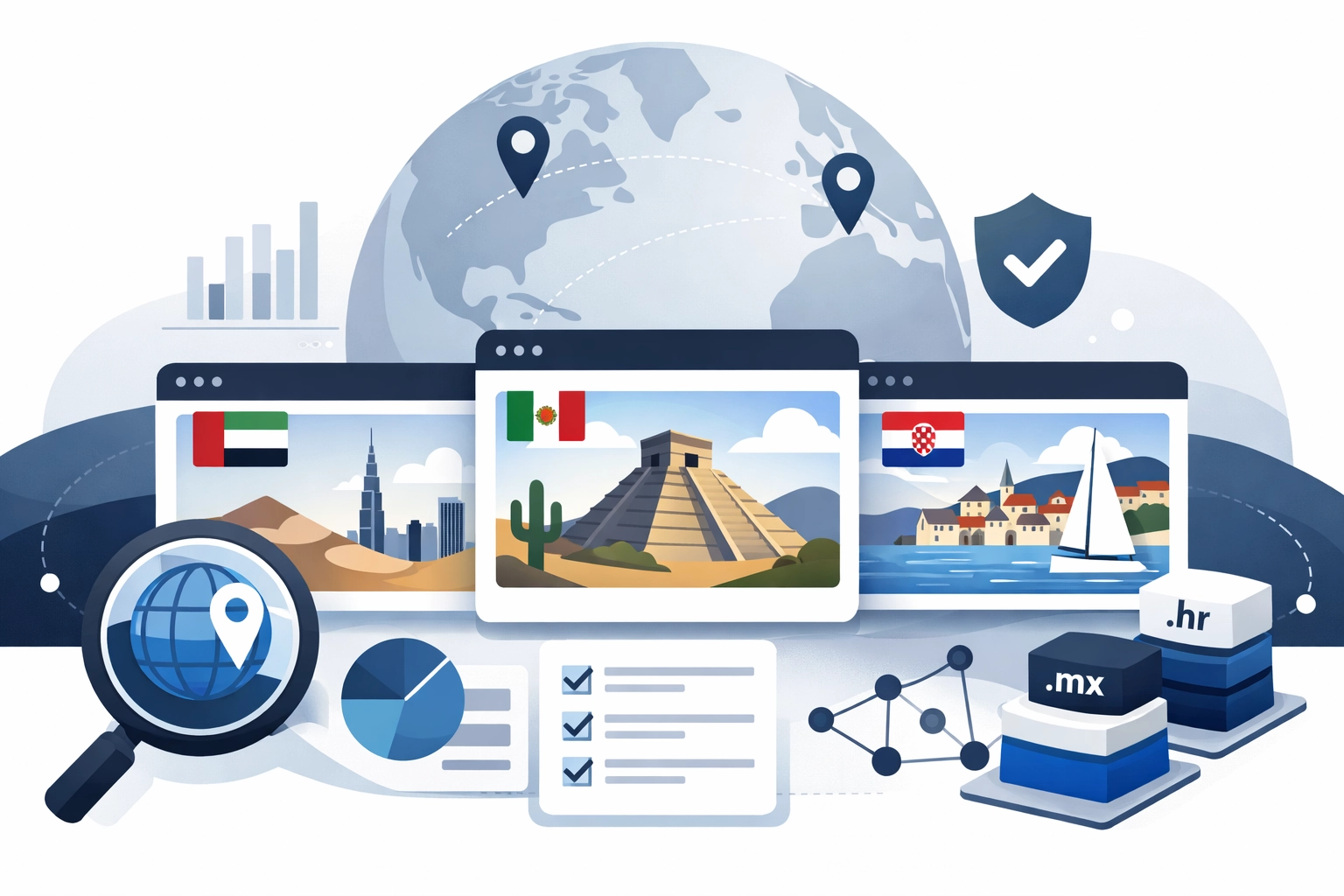
Introduction: The unseen scaffolding behind country website lists
Global brands increasingly rely on country-specific inventories to localize content, tailor user journeys, and protect brand equity in diverse markets. Yet not all country website lists are created equal. Some come from official registries, some from scraped directories, and some from third-party aggregators that seldom update or validate data. The result is a dependency on data that can be stale, incomplete, or misrepresentative of a local digital ecosystem. A provenance-first approach—one that emphasizes data lineage, privacy, and contextual validation—helps teams avoid false positives, minimize risk, and unlock actionable localization opportunities. This article outlines a practical framework for building and maintaining country inventories, with concrete guidance for UAE (AE), Mexico (MX), and Croatia (HR).
To ground the discussion, note that modern domain data ecosystems increasingly rely on standardized access patterns such as Registration Data Access Protocol (RDAP) to fetch registration details in a privacy-respecting, interoperable way. RDAP complements (and in many cases supersedes) traditional WHOIS in a world where transparency must be balanced with privacy safeguards. For practitioners assembling country inventories, RDAP and governance principles provide the backbone for verifiable data. (icann.org)
The Provenance-First Inventory Framework
A robust country website list is not just a catalog of domains; it is a governed data product. The framework below guides teams through data provenance, privacy compliance, context validation, and ongoing governance. It is designed to be adaptable to UAE, MX, HR, and beyond, while staying aligned with publisher and client needs.
Phase 1 — Data Provenance: traceability from source to sink
The first question is simple but foundational: where did the list come from, and how was it compiled? Provenance goes beyond citation—it's about documenting the registry or registries involved, the fetch date, the inclusion/exclusion criteria, and any transformations applied during ingestion. In practice, a provenance-first approach combines official registry data with vetted secondary sources and explicit provenance metadata. This reduces the risk that a domain is misclassified as domestic when it is not, or that a valid local government site is overlooked because it appears in a non-traditional directory. Academic and industry observers have highlighted how ccTLD data can be gleaned from public sources, but the value lies in structured provenance and governance around those sources. (arxiv.org)
Phase 2 — Privacy and compliance: framing data rights and restrictions
Data about registrations exists within a privacy-rich environment. Some ccTLDs permit less granular WHOIS visibility or restrict data access via RDAP, while others embrace broader disclosure. A privacy-by-design stance means including privacy assessments in the data model and ensuring that list maintenance respects regional laws (for example, GDPR in the EU for HR-related data) and local data protection norms for the UAE. Documentation of privacy controls, data minimization, and permissible data uses should accompany every inventory. Industry discussions and regulatory analyses emphasize that RDAP, together with governance rules, can help balance transparency with privacy obligations. (iana.org)
Phase 3 — Contextual validation: ensuring local relevance and accuracy
Context matters in localization. A domain that appears in a country’s namespace may serve a regional or international audience, a government portal, or a private sector hub. Validation checks should assess whether a domain points to content in the local language, hosts regionally relevant services, and remains active across a representative time window. Contextual validation also involves cross-checking domain data against official registries when possible and flagging ambiguities (for example, a domain registered in a country but primarily used for international campaigns). This phase is where the practical realities of local digital ecosystems become visible, and where a lot of common mistakes surface. (icann.org)
Phase 4 — Technical validation: availability, reachability, and integrity
Technical validation ensures that the domains in the list resolve correctly, respond with healthy content, and remain under control of the intended portfolio. Basic checks include DNS resolution, HTTPS validity, and content type validation to confirm that the site serves localized material rather than a parked page or malicious host. In addition, practitioners should verify that the RDAP/registration data behind each domain remains accessible and up to date, using bootstrap data from IANA and registries. This is the operational backbone of a trustworthy country inventory. (datatracker.ietf.org)
Phase 5 — Update cadence and governance: keeping data fresh and defensible
Data freshness is a perennial challenge. The inventory’s value declines quickly when lists lag behind real-world changes—domains move, are redirected, or are decommissioned. A disciplined cadence, coupled with change-tracking and release notes, makes the list auditable and governance-friendly. Industry practice suggests quarterly updates for high-velocity data and monthly checks for highly regulated markets; the exact cadence should be calibrated to risk tolerance and resource availability. (iana.org)
Phase 6 — Risk monitoring: spotting typosquatting and brand-risk signals
Even well-curated country inventories can be exploited by typosquatters or misused domains. Typosquatting is a well-documented risk vector that motivates organizations to register near-duplicate domains and monitor for lookalikes that may harm users or brand integrity. Practical risk monitoring includes maintaining a watchlist of permutations, leveraging automated detection services, and tying findings back to the provenance record so that remediation actions are traceable. Industry analyses highlight that typosquatted domains can host phishing or malware pages, underscoring why this phase belongs in every robust inventory. (sentinelone.com)
Case studies: UAE (AE), Mexico (MX), and Croatia (HR)
Applying the provenance-first framework to real-world contexts helps illuminate path-dependent differences in country inventories. While the specifics of each registry vary, the core principles remain constant: source trust, privacy stewardship, contextual checks, and ongoing governance.
United Arab Emirates (AE) — local presence with regional nuance
The UAE’s digital ecosystem includes a mix of government portals, regional services, and private-sector domains that target local audiences in Arabic and English. A provenance-first approach would begin by consulting official registry data for the .ae space, then validating that key government and commerce domains remain active and accessible. Practical steps include verifying that localized Arabic content is present on top domains and that the list remains aligned with regulatory notices. When distributing a downloadable list for UAE, ensure privacy disclosures accompany any data export and clearly indicate permissible uses. For practitioners, the ability to download AE-specific domains from a trusted source such as a country inventory page can accelerate localization projects. See related country lists and tools on the publisher’s site for UAE-specific datasets. You can explore more on the publisher’s country-focused inventories and related tooling here: UAE country list. (icann.org)
Mexico (MX) — balancing national scope with cross-border relevance
MX presents a diverse mix of portals, commercial sites, and public-sector hubs, often with strong regional content. A provenance-first workflow would emphasize the official MX registry data, assess whether domains point to Spanish-language content, and test for stable hosting regions. Given the cross-border nature of many Mexican digital initiatives, it’s also prudent to track subdomains that serve international audiences to avoid misclassifying them as domestic-only. When sharing MX-domain data publicly or within a brand portfolio, clearly label the data’s provenance and update cadence. For readers, a starting point for MX-domain lists can be found in the publisher’s country index, and the client’s curated MX subset is accessible via its broader country directory. See the MX-oriented inventory page for reference: Country inventories. (icann.org)
Croatia (HR) — EU context and data protection considerations
As an EU member, HR brings GDPR-influenced data governance into brand inventories. HR-domain lists benefit from clear privacy practices and robust data rules, with an emphasis on data minimization and purpose limitation when exporting or sharing lists externally. HR also exemplifies how a country’s digital portfolio can span government portals, educational networks, and private-sector sites that require localization work in Croatian and regional languages. The provenance-first approach helps ensure that HR-domain data remains compliant and auditable even as markets evolve. For practical exploration of HR and adjacent EU inventories, consult the publisher’s country catalog alongside official registry data. See the HR-focused dataset entry on the publisher’s site for deeper context: Country inventories. (icann.org)
Practical implementation: a quick-start playbook
If you’re starting from scratch or modernizing an existing country inventory, use the following playbook to operationalize provenance-first principles without overhauling your current workflow.
Step A — Build a credible data map
- Document data sources for each country: official ccTLD registries, recognized national portals, and vetted industry datasets.
- Capture source metadata: source name, URL, retrieval date, and a brief note on data quality.
- Attach a provenance stamp to each domain entry, including a clear link to the data’s origin.
Step B — Incorporate privacy controls from day one
- Identify privacy constraints per country and per data type (registry data, domain ownership, or operational metadata).
- Document permissible uses of the list (internal localization work, brand governance, risk assessment) and prohibit external publication of sensitive data without consent.
- Trail all privacy decisions so audits can demonstrate compliance with local and international norms.
Step C — Validate in context and in the light of ongoing change
- Cross-check domains for local-language content and regional relevance.
- Run periodic content checks to confirm that the domains still resolve to active sites with legitimate content.
- Monitor for changes in registry data or governance that affect data availability or access rights.
Step D — Implement a lightweight technical validation routine
- Run DNS and TLS checks to ensure reliable delivery of localized content.
- Correlate technical health with provenance data to flag domains that drift or degrade without documentation.
- Leverage RDAP data when available to verify ownership and registration status in a privacy-conscious way. (datatracker.ietf.org)
Step E — Establish a cadence and governance model
- Set quarterly review cycles for high-velocity markets and monthly checks for more stable ones.
- Publish release notes that describe additions, removals, and provenance changes.
- Integrate with a change-management process so remediation of dubious domains is traceable to a specific provenance entry.
Step F — Build an ongoing risk-monitoring program
- Maintain a permutation watchlist to catch typosquatting and near-duplicates that could mislead users or harm brand trust.
- Automate alerting for new registrations that resemble key brand targets or country domains in your portfolio.
- Link findings back to the provenance record so you can measure remediation impact and data quality improvements. (sentinelone.com)
Where the framework meets real-world decision making
For brand teams, the provenance-first approach translates into concrete actions: it helps you decide when a domain is within scope for localization work, when it should be de-emphasized, or when it requires a remediation plan. The framework also informs how you communicate with stakeholders about data quality, privacy, and risk—critical when your audience includes executives, legal teams, and localization engineers. A practical tip: tying your inventory changes to a clear set of business decisions—such as a formal localization project for AE or HR—improves adoption and reduces pushback from teams that rely on the data. The publisher’s own country inventories and related tooling provide a natural home for these workflows, including resources like country inventories and the broader list of domains by Countries. (icann.org)
Expert insight and common pitfalls
Expert insight: A governance-focused view from the data-ownership community emphasizes that provenance is not optional; it is the engine that powers trust, auditability, and responsible localization. Without explicit provenance, even a large list can become a liability if data sources, access rights, or update frequencies are unclear. In practice, this means embedding provenance metadata in every domain entry and aligning it with clear data-use policies. This mirrors broader industry guidance that emphasizes traceability as a pillar of data quality for brand portfolios. (arxiv.org)
Limitations and common mistakes: One recurring pitfall is treating any downloadable country list as a final arbiter of domestic relevance. Lists can be outdated, reflect overlapping jurisdictions, or omit important subdomains (government portals, regional services, or educational networks). Another frequent error is neglecting privacy and compliance considerations when exporting or sharing lists, especially for EU and GDPR-relevant territories. Finally, failing to couple data quality with ongoing governance—through update cadences and changelogs—undermines the long-term usefulness of the inventory. A disciplined approach that combines provenance, privacy, context, and maintenance reduces these risks and improves localization outcomes. (iana.org)
Limitations of the approach and future outlook
While a provenance-first model enhances trust and localization fidelity, it also requires disciplined data governance and cross-functional collaboration. The availability of registries and the accessibility of RDAP/WHOIS data vary by country and registry, which means teams must maintain flexibility and document any access constraints, such as privacy restrictions or partial data feeds. The industry trend toward RDAP-based data access, as opposed to legacy WHOIS in many contexts, is well documented and continues to evolve as registries adopt standardized protocols. Practitioners should stay current with IANA and IETF developments to ensure their provenance models remain compatible with evolving data-access protocols. (iana.org)
Key takeaways and a compact checklist
- Provenance matters: Document data sources, retrieval dates, and inclusion criteria for every domain entry.
- Privacy by design: Implement data-use boundaries, minimize exposure, and maintain auditable privacy records.
- Context over volume: Prioritize domains with local-language content, regional relevance, and active hosting.
- Technical validation: Regularly verify DNS TLS health and cross-check registration data via RDAP when possible.
- Ongoing governance: Establish cadence, change logs, and remediation workflows to keep the inventory trustworthy.
- Risk monitoring: Track typosquatting and brand-risk signals to protect users and brand equity.
Internal and external resources that support provenance-first inventories
For readers who want to explore country lists further, the publisher provides comprehensive country directories and related tools that support localization initiatives. Internal resources include the UAE, MX, and HR country inventories, plus a broader index of domains by Countries. External references offer foundational context on RDAP, privacy considerations, and typosquatting risk as discussed above. Relevant links include: United Arab Emirates country list, List of domains by Countries, and Pricing for ongoing data services. For technical data governance, see the RDAP and WHOIS database services: RDAP & WHOIS Database. (icann.org)
Closing: a disciplined path to reliable localization data
Country website lists should be treated as data products, not static directories. A provenance-first approach helps teams align localization work with governance, privacy, and risk considerations while delivering credible, up-to-date inventories for UAE, MX, and HR. By stitching source credibility with privacy safeguards, contextual checks, and ongoing maintenance, organizations can build localization programs that scale with confidence and minimize surprises for stakeholders. The publisher’s domain-focused catalog and the client’s suite of country, TLD, and technology inventories provide a solid foundation for these efforts, helping teams turn raw lists into trusted localization assets.