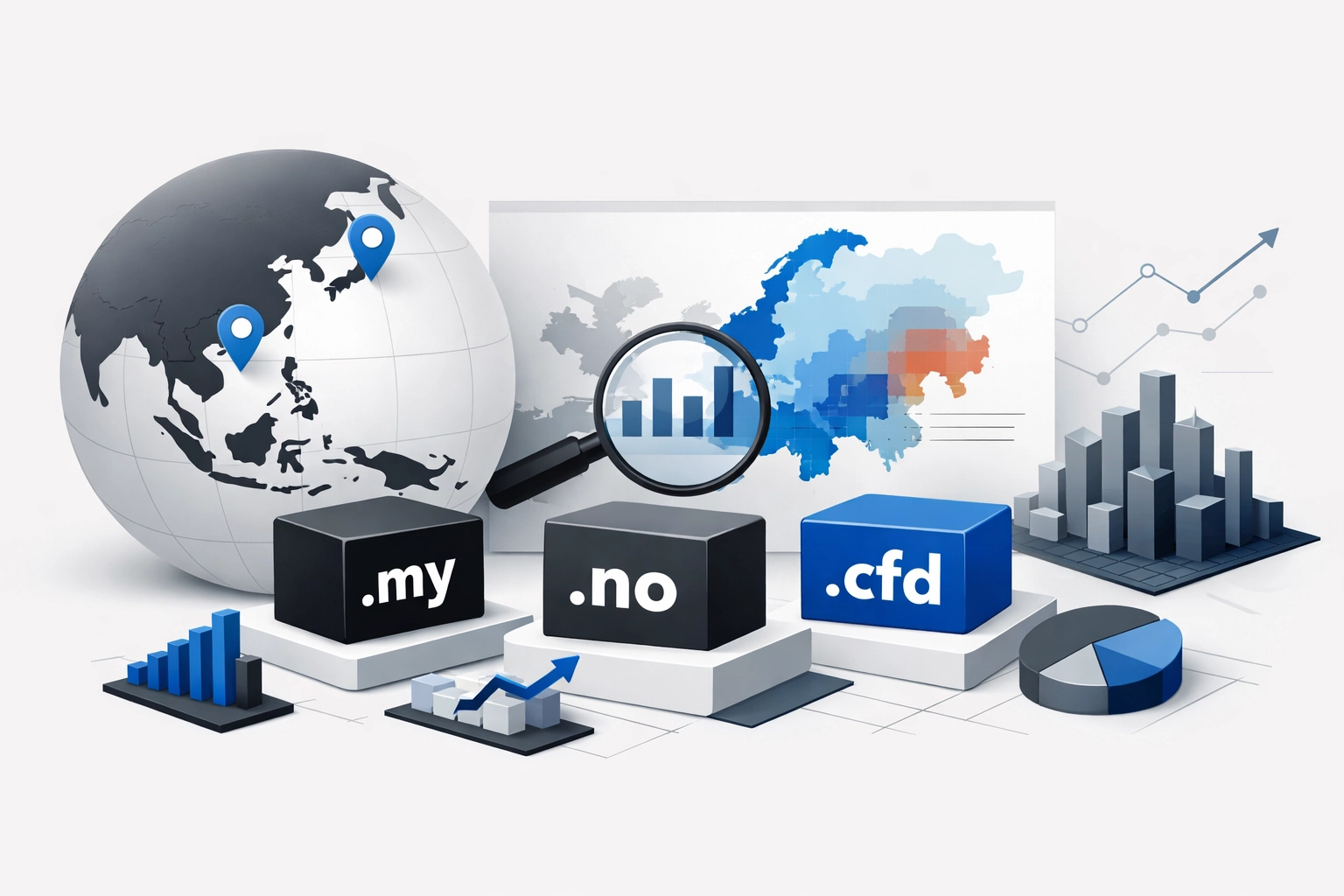
As brands expand beyond familiar terrains, niche top‑level domains (TLDs) offer a structured way to test localization, signal regional intent, and manage brand governance across a sparse but meaningful inventory. This article argues for a practical, risk‑aware approach to building and using inventories for local market experimentation with TLDs such as .my, .no, and .cfd. It is not a call to chase every new extension, but a framework to learn where your content and commerce can land most effectively while avoiding governance or data‑quality pitfalls that commonly derail niche‑TLD programs. For readers who want to explore the core assets behind these ideas, see the Domain Hotlists resources such as Domain My inventory, List of domains by TLDs, and RDAP & WHOIS Database on the client side.
Why focus on niche inventories at all? For global brands, localization is not only about language; it is about signaling relevance and building trust through regionally appropriate digital footprints. Niche TLDs can help you test content density, pricing signals, and local partnerships without committing to a full, expensive country‑code portfolio. The right inventory strategy—carefully curated and governed—lets you observe regional search patterns, content consumption, and brand safety dynamics with a disciplined risk lens. RDAP versus WHOIS data, data privacy considerations, and the current state of data access are central to the practicalities of any data architecture built around these lists. ICANN’s RDAP guidance and the broader move away from traditional WHOIS are changing how researchers and operators access registration data, with implications for automation, privacy, and governance. RDAP is increasingly the baseline for reliable, machine‑readable domain data, but adoption is uneven across TLDs and jurisdictions.
Why niche TLD inventories matter for localization and governance
Domain portfolios are people, not just code. A well‑designed inventory helps you answer core questions: Where is audience demand actually located? Which extensions are most trusted in a given market? How do we map legal risk, brand perception, and content relevance across extensions without inflating cost? The strategic value of niche inventories rests on three pillars:
- Localization signal mapping: Niche TLDs can subtly indicate regional intent and support regionally tailored content‑to‑commerce experiences. In some markets, a local domain can improve trust signals, while in others it may complicate SEO if search engines interpret TLDs differently.
- Brand governance and risk management: Portfolio diversification across TLDs guards against a single‑domain risk and helps you isolate regional compliance requirements, trademark considerations, and content ownership issues.
- Experimental velocity with governance guardrails: An inventory allows rapid, low‑cost experiments—content localization tests, pricing experiments, and channel pilots—within strict governance boundaries to prevent brand dilution or regulatory missteps.
Industry observers emphasize standardized, machine‑readable data to support scalable analysis. For practitioners, RDAP offers a more structured data model than legacy WHOIS, which supports automation and integration into modern analytics pipelines. As ICANN notes, RDAP provides standardized responses and differentiated access, which matters when you scale data processing and enforce privacy controls. RDAP FAQs explain why the shift matters and what to expect as registries move toward RDAP as the primary interface for registration data. (icann.org)
A practical framework for using .my, .no, and .cfd domain inventories
Below is a five‑step framework designed for brand teams and editorial desks who want to explore niche inventories with discipline. It emphasizes how to source, validate, and apply niche domain lists in localization pilots while maintaining governance and data quality. Each step includes concrete actions and examples you can adapt to your own portfolio and editorial needs.
Step 1 — Define objectives and guardrails
Before you touch any list, articulate a short value proposition for the niche inventory: what localization hypotheses are you testing (e.g., regional content relevance, price sensitivity, or channel resonance)? Pair this with guardrails that cover brand safety, legal compliance, data privacy, and cost. A practical guardrail might include: limit the pilot to a defined subset of extensions (e.g., .my, .no, .cfd), cap spend on domain acquisitions or experiments, and implement a review cadence for content changes tied to any new domains.
Step 2 — Source and validate inventories
Inventory quality starts with reliable data sources and transparent validation. For a structured, scalable approach, consider a mix of sources and a lightweight validation workflow:
- Core inventories: Build a baseline from registries and reputable providers that publish extension‑level data and allow bulk access. While there is no universal “download list of .my domains” single source, practitioners often combine registry data with third‑party inventories to map regional footprints.
- Bulk export capabilities: When available, export lists from registrars or portfolio managers. Platforms like Dynadot document steps to export domain lists, showing how bulk data can be obtained and stored for analysis. This demonstrates the practical path from raw registry data to a usable dataset. Dynadot support article explains how users export their own domain lists in CSV format. (dynadot.com)
- Data model and normalization: RDAP provides a standardized, machine‑readable format that makes cross‑TLD comparisons more reliable than the legacy, variably structured WHOIS records. See DomainTools’ overview of RDAP’s advantages and practical implications for domain intelligence. (domaintools.com)
When assembling the inventory, document the data source, the last verification date, and the data quality notes. This creates a repeatable audit trail and makes governance reviews straightforward. ICANN’s RDAP FAQs emphasize that RDAP data can be accessed via standardized endpoints and that, over time, RDAP will become the primary data source for many registries and registrars. This is a practical reason to plan for RDAP in your data pipelines. (icann.org)
Step 3 — Align with brand and compliance requirements
Inventory alignment hinges on brand strategy and regulatory constraints. Consider how each extension is perceived in target markets and whether it intersects with trademark protections, local consumer laws, or disclosure requirements. The Domain Name Marketplace report and ICANN materials highlight how brand portfolios interact with TLD designations and trademark stewardship—especially when a brand contemplates niche brand TLDs or generic domains in geographies with strong local regulations. Understanding these dynamics helps you avoid inadvertent brand conflicts. (icann.org)
Step 4 — Build a test portfolio with guardrails
With validated inventories in hand, assemble a small, controlled experiment set. A practical design might include:
- 5–12 candidate domains across .my, .no, and .cfd to pilot localized landing pages, pricing variations, or editorial experiments.
- A predefined set of success metrics (e.g., local organic impressions, click‑through rates on localized content, conversion to a regional landing page).
- A monitoring plan that uses RDAP data to maintain up‑to‑date registration information, while respecting privacy and differentiated access controls (where available). As DomainTools notes, RDAP enables automation and consistent data across registries, which is essential for scalable pilots. (domaintools.com)
The idea is a small, learnable loop: you test, measure, and either scale or sunset a subportfolio based on explicit results rather than gut feel. If you’re collecting or ingesting large volumes of data, you’ll also want a data quality checkpoint to catch anomalies (e.g., mismatched creation dates or inconsistent status codes) before outcomes drive business decisions. A recent study comparing RDAP and WHOIS data quality suggests there can be gaps that require cross‑checking between sources, especially for less mature TLD ecosystems. (arxiv.org)
Step 5 — Govern, monitor, and evolve
Governance is not a one‑time exercise. Build a lightweight, repeatable governance routine: a quarterly review of the niche inventory against a “risk map” that combines brand exposure, geo‑targeting accuracy, and regulatory compliance. Use RDAP to keep the data current and reduce the risk of stale or misleading information. When you’re ready to expand, incrementally grow the pilot while maintaining the safeguards you established in Step 1. RDAP adoption across TLDs remains uneven, so plan for hybrid data access strategies that combine RDAP with legacy sources where necessary. ICANN’s RDAP FAQs provide a pathway for implementing RDAP in stages, including considerations for differentiated access and the eventual sunset of traditional WHOIS in many gTLDs. (icann.org)
Expert insight and practical limitations
Expert insight: Industry practitioners emphasize that niche inventories must be paired with disciplined data governance and clear editorial objectives. RDAP’s standardized data model is a boon for automation, but it does not automatically guarantee data completeness or uniform adoption across all TLDs. This nuance means you should build hybrid data pipelines and maintain cross‑source validation to avoid blind spots in your localization experiments. As DomainTools puts it, RDAP represents a meaningful leap in data accessibility, privacy, and automation, but it requires a coordinated implementation across registries, registrars, and downstream consumers. (domaintools.com)
Limitations and common mistakes: A frequent pitfall is assuming the inventory is comprehensive and up‑to‑date across all markets. RDAP adoption is growing but not universal, and some regional registries may still rely on older WHOIS interfaces or provide limited access. A 7.6% inconsistency between WHOIS and RDAP data in a broad study reminds practitioners to implement cross‑checks rather than rely on a single data source. Plan for data reconciliation steps and document any known gaps in coverage. (arxiv.org)
A lightweight workflow you can start today
To translate the framework into action, here is a simple, repeatable workflow you can adapt to editorial and brand governance needs. It combines the five steps above with practical tasks you can assign to teams across editorial, product, and legal.
- Define and document objectives in a one‑page brief, including guardrails, success metrics, and a data‑quality plan.
- Assemble validated inventories from at least two data sources (RDAP where available, plus a corroborating source); maintain a data dictionary and field mapping.
- Curate a pilot set of 5–12 domain ideas across .my, .no, and .cfd with clearly labeled localization hypotheses.
- Launch with measurement using a controlled editorial or content experiment on landing pages, pricing, or channel presence; monitor ROAS, engagement, and trust signals in target regions.
- Review and decide on expansion, contraction, or sunset based on pre‑defined thresholds; update governance documents accordingly.
Limitations of this approach and common mistakes to avoid
- Over‑reliance on a single data source. RDAP is powerful, but adoption varies by TLD, and some registries may still rely on non‑standard interfaces. Cross‑checking with multiple sources reduces blind spots. ICANN’s RDAP FAQs acknowledge that RDAP implementation is not uniform across all registries and registrars. (icann.org)
- Assuming inventory completeness. A niche inventory is a signal, not a guarantee. The arXiv study on domain intelligence notes potential gaps in domain data and the need for robust validation pipelines. Treat inventories as living datasets with periodic refreshes. (arxiv.org)
- Ignoring brand protection when expanding into new extensions. The ecosystem around brand TLDs, and how they intersect with trademark law, requires careful alignment with internal brand governance policies. For readers planning a brand‑risk assessment, see ICANN’s coverage of brand TLD designations in the broader marketplace context. (icann.org)
Putting it into practice on Domain Hotlists and client resources
Domain Hotlists thrives when editorial quality and data integrity meet practical business needs. Use a niche inventory as part of a broader brand governance program, weaving editorial insight with data signals. When you need to explore these lists in a structured way, the client resources offer concrete entry points: the core inventory page for .my, the broader catalog of domains by TLDs, and the RDAP/WHOIS database for ongoing data lookups. The represented URLs below are excellent anchors for ongoing work and governance alignment:
Beyond internal use, consider how the same framework could be scaled to other TLDs and geographies as your localization program grows. To maintain editorial integrity and accuracy, avoid over‑generalizing results from niche inventories to broad markets. This is particularly important when you incorporate “download list of .my domains” or similar lists into automated workflows; always subject bulk data to governance reviews and privacy safeguards before use in content or product experiments. For readers seeking a practical view into bulk domain list handling, Dynadot’s guide on downloading domain lists demonstrates how teams collect and export domain inventories for portfolio management. (dynadot.com)
Conclusion
Local market experimentation through niche TLD inventories is not a silver bullet, but a measured, governance‑driven approach can illuminate where content and commerce can resonate locally without bloating risk. By pairing a clearly defined objective with a validated inventory, a lightweight but robust governance framework, and an editorial lens that respects brand integrity, organizations can build a structured path to localization that scales. As data access transitions to RDAP across registries and new frontiers of privacy‑aware data become the norm, the practical path forward combines standardization with prudent governance. For editors and brand teams at Domain Hotlists, this framework offers a rigorous but actionable way to translate domain data into domain strategy that is both editorially credible and commercially responsible.