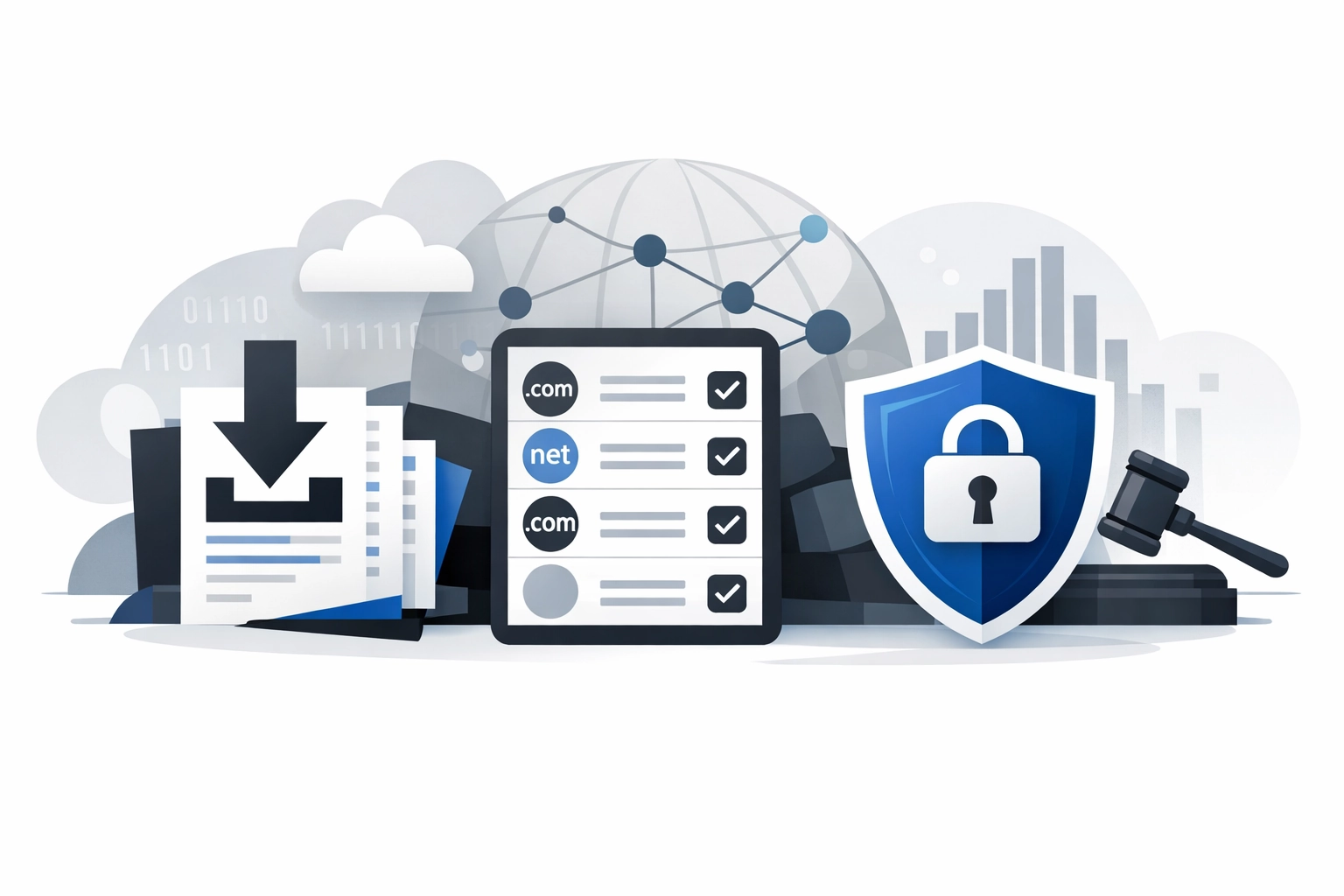
Bulk domain lists promise scale: a quick route to assess regional exposure, monitor competitors, and seed localization efforts. Yet for brand protection teams, startups, or agencies managing global portfolios, the raw download is only the beginning. Without governance, provenance, and ongoing hygiene, these lists become expensive liabilities rather than strategic assets. This article offers a practical framework—grounded in data governance best practices and current domain data realities—for turning a downloadable domain list (including popular targets such as .za, .click, and .id domains) into a compliant, auditable inventory that informs decision-making and regional growth while reducing risk.
For context, the Internet’s registration data landscape is changing. RDAP is increasingly the standard for accessing registration data, a shift that ICANN has been guiding since the late 2010s and that accelerated with the sunset of the traditional WHOIS for gTLDs in 2025. Adoption among country-code top-level domains (ccTLDs) varies, and many ccTLDs still operate with their own policies or different data-access practices. This evolving environment makes governance even more essential for any organization relying on downloadable domain lists. RDAP provides a structured, machine-readable data model that helps organizations programmatically validate, enrich, and audit domains, but it also introduces considerations around data completeness and privacy. (icann.org)
Two diverging forces shape what you can and should do with downloadable domain data. On one side is a push for richer, interoperable data (RDAP’s structured fields, better validation, and more reliable programmatic access). On the other side is data privacy and governance—GDPR-inspired redaction and the consequent challenges for investigations and brand-protection workflows. Industry sources emphasize that data provenance and governance are not optional; they are foundational to turning lists into legitimate, auditable assets. For practitioners, this means designing workflows that respect data origin, ensure proper use, and maintain a clear lineage from download to application. Data governance frameworks such as DAMA-DMBOK provide the backbone for these practices, ensuring that data quality, stewardship, and policy management are embedded in everyday operations. (datatracker.ietf.org)
Why bulk domain lists require governance
The allure of bulk lists is undeniable: you can sweep up thousands of domains across geographies and technologies in a single download. The reality, however, is nuanced. In practice, a bulk list is rarely a pristine, ready-to-use asset. It often arrives with gaps, inconsistent field names, or variations in how data was collected. In addition, ongoing policy changes—such as moves from WHOIS to RDAP and the privacy rules that accompany them—mean you must account for evolving data availability and visibility. A disciplined approach to governance helps you navigate these friction points rather than letting them derail your initiatives.
- Data lineage matters. Knowing where a list came from, when it was generated, and under what terms it can be used is essential for compliance and repeatability. ICANN and IETF emphasize that modern domain data access is moving toward RDAP as the standard, which strengthens consistency but also highlights the need for clear provenance and licensing. RDAP is designed to replace WHOIS with a more structured data model. (datatracker.ietf.org)
- Privacy and data minimization cannot be ignored. GDPR-era policies and the practice of redacting or masking contact data in some RDAP queries complicate outreach and investigations. Redaction can hinder risk assessment and enforcement actions, which is why governance must address not just data access but also lawful and ethical use. (interisle.net)
- ccTLD heterogeneity demands caution. While gTLDs have moved toward RDAP in many cases, ccTLDs vary in adoption, policy, and data exposure. This heterogeneity reinforces the need for explicit governance rules about data sources, allowable uses, and risk management. (domaintools.com)
These realities underscore a simple but powerful premise: bulk lists should be treated as inputs to a governance-driven workflow, not as self-contained assets. The following framework offers a practical path from raw download to a verifiable portfolio that supports brand protection, localization strategies, and compliance requirements.
A governance framework for turning downloads into an auditable inventory
To convert a downloaded domain list into a trustworthy inventory, adopt a governance framework that codifies provenance, quality, and usage policies. A robust starting point is a framework inspired by DAMA-DMBOK, which emphasizes data governance, stewardship, and data quality as the foundation of any data asset. The core idea is to build a repeatable, auditable process that produces an inventory with traceable lineage, clear ownership, and documented usage rules. This approach aligns with industry practice and helps ensure you can defend decisions and actions tied to the inventory. DAMA-DMBOK’s refreshed emphasis on governance and data management disciplines provides practical scaffolding for this work. (dama.org)
PROOF: provenance, relevance, ownership, opt-out, frequency
We propose a concise, repeatable five-part framework—PROOF—for turning a download into a governance-ready inventory. Each element plays a distinct role in risk management and decision-making.
- Provenance: Document the data source, its license, and the extraction method. Capture metadata such as download date, the exact list version, and the expected scope (e.g., TLDs included, technologies, and any filters applied). RDAP and WHOIS data’s structured fields facilitate provenance tracking, and the RDAP ecosystem is designed to support auditable data flows, especially as WHOIS retires in many contexts. (datatracker.ietf.org)
- Relevance: Ensure the data aligns with the project’s goals (region, market, or technology focus). Not every domain in a bulk list will be relevant to a given brand strategy; governance should include a relevance filter and a defined lifecycle for re-evaluation as goals shift. Note that ccTLD adoption of RDAP and data visibility varies by country, so you’ll want a policy that accounts for data gaps and alternative data sources. (domaintools.com)
- Ownership: Assign a data steward and set access controls. Ownership includes who may use the data, for what purposes, and under what contract terms. This is particularly important as lists may be used for competitive intelligence, localization, or risk assessments that implicate privacy and competitive concerns. DAMA-DMBOK emphasizes stewardship as a core practice for data assets. (dama.org)
- Opt-out/Privacy compliance: Implement rules for compliant usage, including respecting redacted fields and avoiding misuse of sensitive data. The GDPR-driven redaction trend affects how you can contact or enumerate parties tied to certain domains; your governance should document permissible use and retention windows. (interisle.net)
- Frequency: Define how often you refresh the data, update provenance, and run quality checks. Given the ongoing RDAP deployment and the evolving data landscape, a cadence that balances timeliness with stability is essential—especially when you depend on these lists for ongoing brand protection or localization efforts. (ietf.org)
Ingest workflow: from raw lists to a defensible portfolio
Transforming a raw download into a governance-ready inventory requires a concrete, repeatable workflow. The following steps map to the PROOF framework and reflect best-practice data management patterns described in industry sources and governance literature.
- 1) Validate provenance: Collect and store source metadata (where the list came from, terms of use, and download timestamp). If you pulled a file labeled as a domain list from a third party, document the exact supplier, the version, and any terms that restrict reuse. This step is foundational for auditability and risk management.
- 2) Normalize data fields: Normalize domain entries, status flags (active, parked, expired), and any extra attributes (region, TLD, technology). Consistent field names and formats reduce downstream errors and simplify automation.
- 3) De-duplicate and validate: Remove duplicate domains and verify that each domain entry conforms to standard domain syntax. This minimizes false positives in risk assessments and avoids bloated inventories.
- 4) Enrich with registration data: Use RDAP endpoints to enrich entries with registration metadata where available. RDAP’s structured data model supports automated enrichment and better data quality than traditional flat lists. This step is where you begin to turn a raw list into an active asset. (datatracker.ietf.org)
- 5) Assess privacy and compliance constraints: Cross-check any data that appears with personal contact details or identifiers. Where data is redacted or limited, plan alternative workflows (e.g., focus on domain-level risk indicators rather than contact- or owner-level outreach). This aligns with privacy-driven trends in the RDAP ecosystem. (interisle.net)
- 6) Versioning and retention: Maintain versioned exports, an audit trail of changes, and clear retention policies. Version control ensures you can reproduce analyses and defend decisions if data policies change.
- 7) Output and governance-ready artifacts: Produce a domain-inventory artifact that includes provenance, enrichment results, and usage notes. Attach policy statements and usage restrictions to the artifact so future users understand the governance context.
Practical application: a scenario with .za, .click, and .id lists
Consider a typical scenario where a team downloads domain lists targeting specific regions or verticals. A practical approach is to use the framework to guide evaluation and usage. Here are concrete actions aligned with the framework:
- Provenance: Confirm that each list originates from a legitimate, licensable source and capture the exact export date. If you used download list of .za domains as a regional seed, note the source and version explicitly. You can supplement the seed with other lists such as a broader “List of domains by TLDs” page to identify cross-reference opportunities. For example, the domain ecosystem showcased at https://webatla.com/tld/za/ can provide context about country-specific assets, while a broader TLD directory can reveal expansion paths. (datatracker.ietf.org)
- Relevance: If your goal is regional growth in Southern Africa, filter the .za seed by status and activity, then compare against similar seeds from .co.za or neighboring ccTLDs. A parallel exercise with .click and .id seeds can surface cross-border risk indicators and localization opportunities. RDAP-enriched data makes this cross-reference feasible at scale. (datatracker.ietf.org)
- Ownership: Assign a data steward for the regional seed and ensure access controls reflect the sensitivity of the data, particularly when lists include more than domain names (e.g., registration data via RDAP). DAMA emphasizes stewardship as a core data-management practice. (dama.org)
- Opt-out/Privacy: Respect data minimization principles; redact or mask sensitive fields where required and document permissible use cases for the inventory. Privacy-focused considerations are increasingly central to the RDAP ecosystem, and governance should reflect that reality. (interisle.net)
- Frequency: Establish a cadence to refresh the seeds (e.g., quarterly) and re-run enrichment and governance checks. The RDAP adoption trajectory continues to evolve, with ongoing policy updates from ICANN and industry observers noting the broader transition away from legacy WHOIS. A disciplined cadence helps ensure the inventory stays relevant and defensible. (ietf.org)
Expert insight and common limitations
Expert view: In governance-intensive work, the two non-negotiables are clearly documented provenance and explicit permissible uses. A data-governance veteran notes that without provenance, a bulk list is a liability rather than an asset, because you can’t defend decisions or demonstrate compliance if data origins and licenses are murky. The same expert warns that even a well-governed inventory can become stale if you don’t refresh data and re-validate sources on a regular cadence. The takeaway is simple: build provenance into every workflow and treat data updates as a governance event rather than a backend task.
Limitation and common mistake: A frequent misstep is assuming that “download = usable.” Real-world workflows must account for data quality, licensing, and privacy constraints. The worst-case outcome is a portfolio that looks comprehensive but cannot be used to drive actions or protections because its lineage is unclear or its terms of use are violated. It is precisely these risks that make a governance framework essential. Industry sources emphasize that governance, not merely data collection, is what separates a defensible domain portfolio from a risky asset. (dama.org)
Where this fits into the broader domain-data ecosystem
The domain-data landscape sits at the intersection of data governance, privacy regulation, and a rapidly evolving data-access protocol. RDAP’s standardized data model is designed to improve interoperability, which in turn supports scalable governance workflows. As ICANN notes, RDAP is part of a broader effort to modernize how registration data is accessed and used, with governance considerations embedded in policy and practice. This means your organization can build an auditable, repeatable process that scales with data-flow changes while still respecting user privacy and regulatory requirements. (icann.org)
Limitations and practical mistakes to avoid
- Avoid treating raw downloads as final assets. A domain list is an input, not the end product. Without governance steps, it’s easy to misinterpret stale or incomplete data as current truth.
- Ignore data provenance at your peril. If you don’t document source, licensing, and version, you can’t defend actions taken on the basis of the data. This is a fundamental governance shortcoming that DAMA-DMBOK warns against. (dama.org)
- Underestimate privacy’s impact on usage. Redactions and evolving privacy controls can limit direct outreach or verification—plan for alternative workflows and document them. (interisle.net)
- Over-rely on ccTLDs’ uniformity. Adoption of RDAP and data-access policies varies by ccTLD; assume gaps and design workflows that tolerate missing fields or alternative data sources. (domaintools.com)
- Skip governance artifacts. Without attached usage policies, retention notes, and audit trails, the inventory isn’t auditable and can’t support risk management or legal actions. DAMA-DMBOK and related governance literature stress the importance of artifacts accompanying data assets. (dama.org)
Conclusion: turning downloads into defensible assets
Downloaded domain lists, including seeds drawn from download list of .za domains, download list of .click domains, or download list of .id domains, can be powerful inputs for regional strategy and brand protection when they are governed as data assets. The practical pathway is clear: document provenance, normalize data, enrich with RDAP data where available, respect privacy constraints, and define a transparent cadence for refreshes and audits. This governance-first approach aligns with established data-management practices and supports real-world outcomes—from targeted localization efforts to more resilient brand portfolios. For organizations seeking a practical starting point, consider using these resources to seed your governance workflow and then leverage your internal data stewardship to maintain the inventory over time.
For ongoing access to related domain data and governance-ready resources, you can explore the client resources that discuss country-TLD and technology-based inventories, or the RDAP & WHOIS database hub for authoritative data management and lookup capabilities. In particular, the broader WebAtla resource set includes targeted lists by TLD and by country, as well as a dedicated RDAP/WDS database, which can help operationalize the PROOF framework in practical workflows. RDAP & WHOIS Database and List of domains by TLDs offer reference points for building a provable, auditable domain portfolio. For direct seeds, you can review sector-specific lists such as .za, .click, and .id. (datatracker.ietf.org)