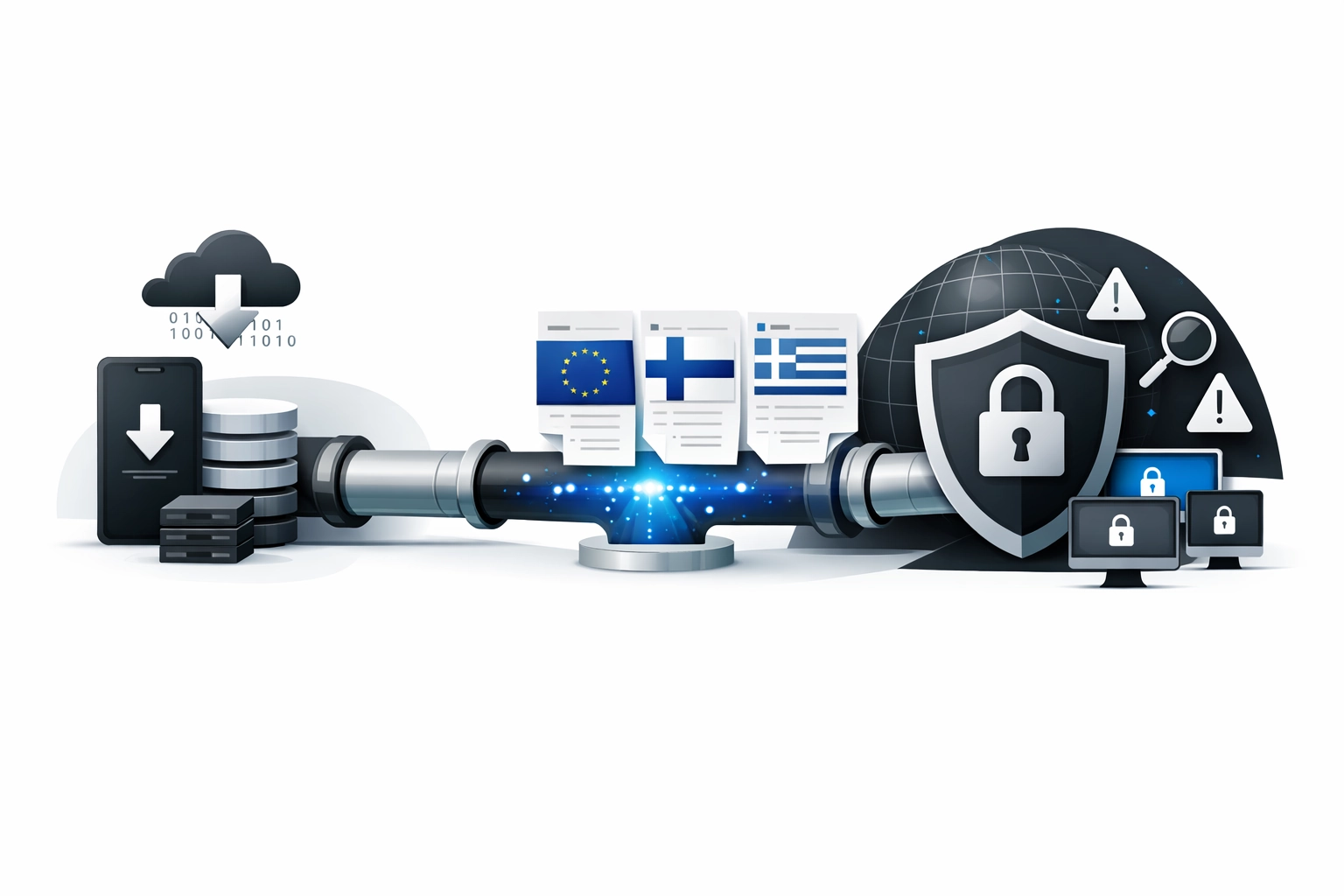
Introduction: turning downloadable domain lists into real-world defense
Companies increasingly recognize the domain surface as a critical risk vector—especially in complex digital supply chains where vendors, partners, and affiliates operate across many TLDs. Downloadable domain lists—such as sets of .link, .tv, or country-code domains like .pt—offer a practical starting point for risk assessment, brand protection, and regulatory compliance. But a list alone doesn’t automatically translate into protection. The real value comes from turning data into governance: standardizing how you ingest, verify, and act on domain data, and tying that data to decision workflows across procurement, security, and brand teams.
In 2025 ICANN formally sunset the legacy WHOIS model in favor of the Registration Data Access Protocol (RDAP), a shift that has serious implications for how organizations source and interpret domain registration data today. RDAP provides structured JSON data with standardized fields, which streamlines automation but also requires disciplined data provenance and governance to avoid misinterpretation. As ICANN puts it, the RDAP transition is a foundational change to how domain data is delivered and consumed across registries and registrars. As of January 28, 2025, RDAP became the definitive source for gTLD registration information, replacing WHOIS for most ecosystems. This milestone informs how we approach downloadable lists in a defensible, auditable way.
This article walks through a practical framework for using downloadable domain inventories as part of a risk-management playbook—how to read data, where to anchor your decisions, and how to avoid common mistakes that undermine even the best data sources. We’ll illustrate how to apply this in vendor risk programs, with a focus on niche TLDs such as .link, .tv, and .pt—domains often overlooked in broader, bulk-registration strategies but rich with signaling power for brand integrity and supply-chain risk. For those looking to extend insights across your portfolio, see how this dovetails with the RDAP/WHOIS database capabilities provided by our client, and related domain lists by TLDs.
Section 1: why niche domain inventories matter for risk, compliance, and brand protection
Domain inventories are not just a marketing exercise; they are a governance tool. The value of a well-constructed inventory lies in three dimensions: discovery (finding potential risks across the surface), monitoring (tracking changes and new registrations), and response (acting on findings with cost-effective controls). When you focus on niche TLDs—such as .link, .tv, or country-specific domains like .pt—you capture signals that broader domain lists may miss. These signals can indicate brand impersonation risks, misdirection in partner sites, or potential brand dilution in markets where you operate, contract, or source components.
Understanding how to work with domain data today also means acknowledging data provenance and data quality issues. RDAP offers structured data with explicit fields for registrant, contact, and event history, in contrast to the older WHOIS model, which delivered free-text data that was harder to machine-parse at scale. The shift to RDAP has been widely discussed in industry forums and official resources, with ICANN explicitly outlining the sunset of WHOIS for gTLDs in 2025 and the ongoing adoption of RDAP across registries and registrars. This transition is essential when you plan to build automated risk workflows that rely on consistent data formats. RDAP provides JSON responses and standardized fields, improving automation and auditability, but you must still validate data provenance and consider redactions that privacy rules may impose. (icann.org)
Real-world governance benefits emerge when you map domain data to risk outcomes. For brand protection, inventories help identify typosquatting, impersonation risks, and brand-variation registrations across TLDs. For supplier and vendor risk, inventories support due-diligence workflows: do your vendors operate or rely on domains in overlapping namespaces? Are there parallel domains that could be used to misdirect customers or siphon traffic? The practice of compiling, cleaning, and integrating these lists into a formal risk workflow is now a standard part of robust brand governance. For practical context, tech-adoption leaders frequently cite the need to connect domain data to broader risk programs, including brand monitoring, trademark enforcement, and security controls. A growing body of practitioner resources emphasizes turning domain portfolio data into defensible decisions and auditable processes. Case in point: a well-governed domain portfolio supports risk- and privacy-compliant vendor onboarding and ongoing supplier risk reviews. (cscdbs.com)
Section 2: a practical framework to turn downloadable lists into risk-management outputs
Below is a four-step framework designed to help teams translate downloadable domain inventories into risk-signaling dashboards, vendor risk workflows, and brand-protection actions. Each step is intentionally concrete, with concrete activities you can schedule in a quarterly or monthly cadence. Throughout, we’ll reference best-practice concepts from industry sources and align with the RDAP-era data landscape.
Step 1 — Define scope, risk appetite, and success metrics
- Clarify which niche TLDs to monitor and why (for example, .link, .tv, .pt). Tie the choice of TLDs to brand exposure, market presence, and critical supplier geographies. The goal is to build a focused inventory that is manageable, measurable, and relevant to your risk profile.
- Define risk indicators you will monitor in the inventory, such as: new registrations that mirror your brand, domains with typos in key markets, and domains owned by known risk actors tied to your vendor ecosystem.
- Set success metrics that matter to stakeholders: e.g., MTTR (mean time to respond) for risk alerts, reduction in brand-impersonation incidents, and improved screening pass rates in vendor onboarding.
In practice, this means your team agrees on what “done” looks like for monthly risk reports and quarterly governance reviews. As a baseline, organizations that manage portfolios across many TLDs increasingly tie risk outcomes to formal governance processes, with portfolio management becoming a core function of brand protection and procurement risk teams. The literature on domain portfolio management emphasizes treating domain assets as governance-relevant assets that require routine, metric-driven oversight. (dynadot.com)
Step 2 — Ingest, normalize, and validate domain data (RDAP-first where possible)
- Adopt a RDAP-first approach for data ingestion, recognizing that RDAP is the modern standard for domain data, with a documented sunset of the plain WHOIS service for gTLDs beginning in 2025. RDAP’s JSON responses enable more reliable parsing and automation, but data quality still depends on the source registries and any privacy-related redactions. (icann.org)
- Implement data normalization to map fields across sources (domain, registrant, creation date, status, DNS records, and event history) into a single schema that your risk system can consume. This step reduces manual cleanup and supports downstream analytics.
- Implement provenance tracking: record data source (which RDAP server or registry), the timestamp of the lookup, and whether data was redacted or partially redacted due to privacy controls. Provenance matters for audits and for defensible decision-making, especially in regulated contexts.
Practitioners note that RDAP’s standardized data model makes automation far more feasible than the old WHOIS approach, but uniform adoption across all registries is still evolving in some locales. This is why a robust ingestion layer should accommodate mixed data sources while clearly indicating data quality issues. Industry sources describe RDAP as the evolutionary successor to WHOIS, designed to support structured data suitable for automated processing and risk workflows. (whoisxmlapi.com)
Step 3 — Map inventories to vendors, brands, and markets
- Cross-reference the inventory against your vendor roster and partner ecosystems. Look for overlaps between vendor domains and your brand namespaces, and identify potential surface-area expansion as new vendors join your supply chain.
- Filter risk signals by geography and business function. For example, a vendor operating in a high-risk region may warrant closer monitoring of local TLDs or a precautionary registration program for protective domains in those markets.
- Translate signals into concrete actions—monitoring alerts, defensive registrations, or contractual controls—aligned with your risk appetite. The goal is to create a structured workflow that moves from detection to decision to remediation.
Industry discourse on risk and brand protection consistently emphasizes the importance of turning domain signals into governance actions, not merely listing domains. Studies and practitioner guides stress that a well-governed domain portfolio supports risk management, brand security, and compliant vendor onboarding. Real-world governance hinges on turning data into timely, auditable decisions. (cscdbs.com)
Step 4 — operationalize outputs, govern with a light-touch framework
- Deliver risk dashboards and quarterly governance reviews that show trend lines, incident counts, and the status of critical domains across the portfolio. The dashboards should be consumable by security, brand, and procurement stakeholders alike.
- Establish a defensible process for responding to risk signals: asset-vs-identity checks, alert triage, and a defined escalation path for high-risk domains (e.g., those closely mirroring a trademark or a key supplier brand).
- Document policies for data sharing and privacy, ensuring compliance with applicable laws and ICANN RDAP/RAA guidance. Treat your inventory as a governance asset, not just a data dump.
This governance-oriented approach is echoed across authoritative sources that describe domain portfolios as strategic assets requiring formal oversight, including risk, privacy, and security considerations. The transition to RDAP is a structural enabler for this governance, enabling programmatic handling of domain data while highlighting the need for robust governance processes. (cscdbs.com)
Section 3: expert insight and practical considerations
Expert insight: RDAP’s standardized JSON data and explicit fields enable automation and scalability for domain risk programs. At the same time, the data can be incomplete or selectively redacted due to privacy rules, so teams must design validation workflows that account for data provenance and data quality variability. This means that even with RDAP, your risk decisions should be anchored in corroborating signals (e.g., DNS data, brand-monitoring results, and supplier attestations) and not on a single data feed. In practice, many organizations layer RDAP-derived signals with other governance inputs to reduce blind spots.
What this means for practitioners is simple: rely on RDAP for structure and automation, but assume a data quality curve that requires human oversight, especially when evaluating supplier risk or brand impersonation threats in niche TLDs. The broader literature and industry analysis reinforce this view—domain data is powerful when combined with governance, but not a substitute for due-diligence processes and legal review. (novagraaf.com)
Limitations and common mistakes: what to avoid when using downloadable domain lists
- Mistake 1: treating a downloaded list as a current, comprehensive map of risk. In practice, lists require regular refreshes, cross-checks against live RDAP lookups, and reconciliation with vendor activity. RDAP adoption is widespread but not universal in all registries, so mixed sources are still common.
- Mistake 2: assuming data is equally accessible for all fields. RDAP provides structured data, but privacy rules can redact or limit visibility of registrant details, which complicates identity matching and risk scoring. Provenance and context are essential.
- Mistake 3: neglecting data provenance. Without recording source, timestamp, and data quality notes, you cannot justify risk decisions in audits or regulatory inquiries.
- Mistake 4: overlooking legal and compliance considerations around bulk domain handling. Bulk strategies can collide with trademark rights and fair-use expectations; legal review remains essential.
- Limitation: even with RDAP, not all NICs expose the same fields, and differences in data quality across registries can lead to uneven risk signaling. A robust program must incorporate data-verification steps and fallback sources.
This reality is echoed by practitioners who emphasize that domain data quality, privacy, and governance must co-evolve with data feeds. Reputable sources on bulk registrations and brand protection urge a careful balance between defensive registrations and trademark enforcement to avoid legal risk while maintaining brand integrity. (dn.org)
Practical example: a four-domain, vendor-risk use case
Consider a mid-sized manufacturing company onboarding five new suppliers in the European market. The procurement team has a roster of vendor domains that includes major country-code TLDs and a handful of niche TLDs where these suppliers are active. They pull a downloadable inventory that includes several niche TLDs (for instance, .pt for Portugal and .tv for media-related partner sites) and cross-check against the RDAP data for each discovered domain. The team follows the four-step framework:
- Step 1: Define scope and success. The team agrees to monitor domains that resemble the company’s brand name and key supplier domains in the target markets, with quarterly risk-review meetings and a goal of reducing impersonation alerts by 40% year-over-year.
- Step 2: Ingest and validate. RDAP-based lookups are automated to fetch current data, with provenance tracked (source endpoint, lookup time, and data quality flag). The team notes any redactions and uses DNS data from secondary checks to corroborate ownership claims where RDAP is incomplete.
- Step 3: Map to vendors and markets. The inventory is matched against supplier lists; domains that parallel vendor names or that could be misused to impersonate a supplier trigger alert escalations to SCRM and Brand Protection teams.
- Step 4: Act and govern. The organization implements a tiered response plan: continue monitoring, register defensive domains in high-risk cases, revoke or update access controls on supplier portals, and document the outcome in quarterly governance reports.
This case illustrates how a disciplined approach—grounded in RDAP-driven data, provenance, and governance—transforms a raw download into an auditable risk program that can be explained to executives and validated in audits. As with any real-world program, success hinges on coordination across procurement, security, and brand teams, and on maintaining clear records of decisions and data sources.
Integrating the client’s tools and resources
For teams building these workflows, our client’s data capabilities provide a natural backbone: a comprehensive RDAP & WHOIS Database to support RDAP-based data ingestion and provenance, and List of domains by TLDs to scope niche inventories and cross-check against local regulatory realities. When evaluating cost and governance options, the Pricing page offers useful context for scale and automation.
Beyond those client capabilities, other credible sources emphasize the importance of robust risk governance around domain data, including the need to build master inventories, monitor new registrations, and align domain decisions with brand strategy and regulatory requirements. For organizations looking to expand their domain-signal program, consider how to pair these inventories with brand-monitoring, trademark enforcement, and supplier-risk workflows. (cscdbs.com)
Conclusion: turning lists into governance you can audit and defend
Downloadable domain inventories are a practical and scalable input to vendor risk management and brand protection programs. The key to realizing their value is not merely collecting data but embedding it within a governance framework that combines reliable data sources (RDAP) with provenance, business context, and auditable decision-making. The RDAP transition, officially in place for gTLDs since January 2025, provides the structured data foundation that enables automation and scalable risk management. Yet data quality, privacy redactions, and the need for cross-functional processes remain central to effective risk programs. By applying the four-step framework outlined here, teams can move from “download” to “defense”—transforming niche domain inventories into proactive governance that protects brands, strengthens supplier risk management, and supports compliant, auditable outcomes. For organizations seeking to build or extend such capabilities, the client resources cited above offer practical foundations and scalable options to power these workflows.