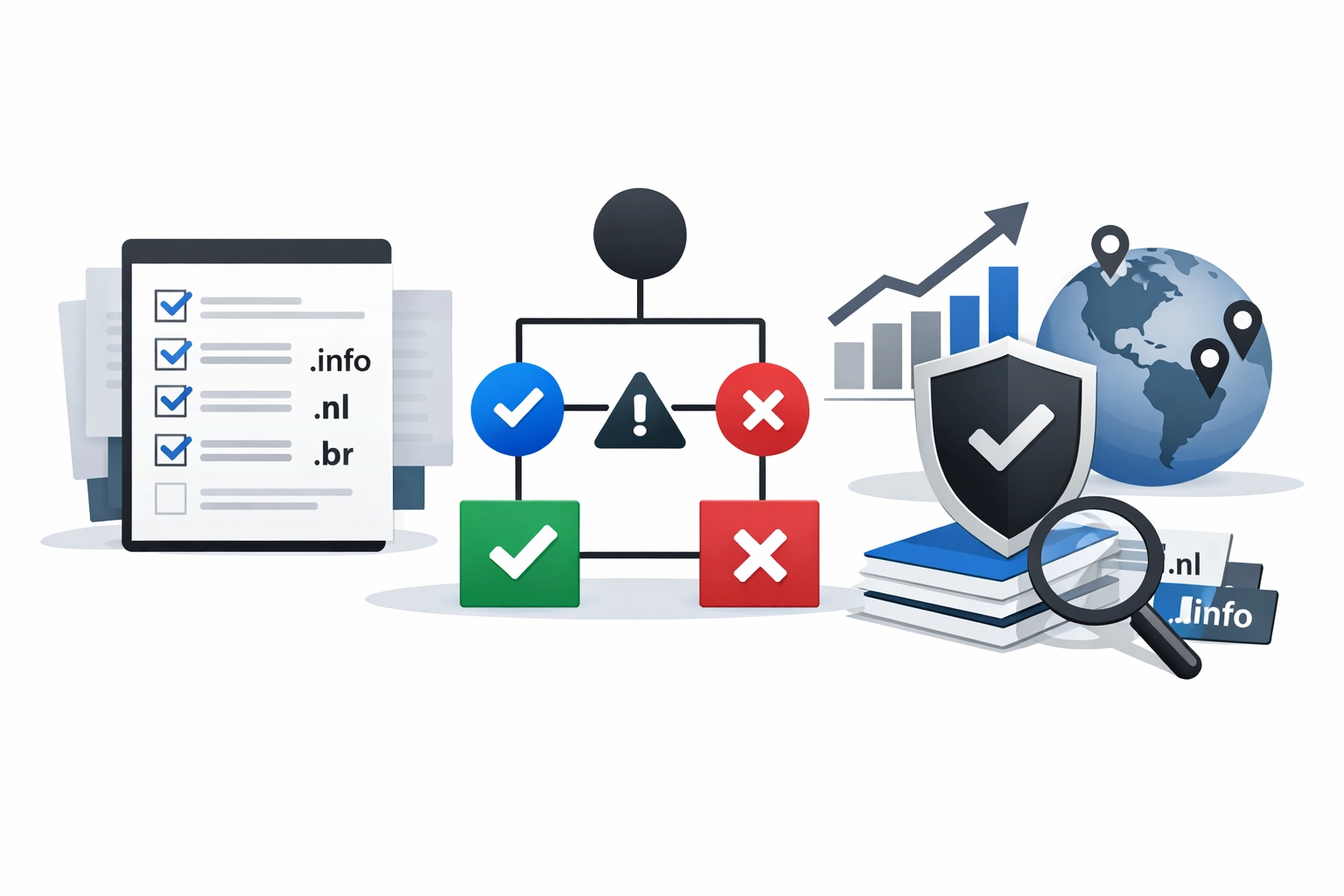
Introduction: why startups should care about niche TLD inventories
For many startups, the domain namespace feels like a sea of distractions rather than a strategic asset. Yet the namespace is more than a landing page; it’s a signal about brand positioning, audience reach, and risk exposure. A growing practice is to leverage downloadable domain lists as a data-informed input for branding, localization, and risk management decisions. In particular, niche top‑level domains (TLDs) such as .pk, .win, and .makeup present unique opportunities and risks: they can open doors to local audiences, gaming communities, or niche markets, but they also raise questions about data quality, governance, and brand safety when used at scale. This article offers a practical framework to move from bulk lists to deliberate, governance-driven decisions that fit a startup’s growth trajectory. Key takeaway: bulk domain lists are a tool—use them with provenance and guardrails, not as a substitute for focused brand strategy.
Expert insight: RDAP, the modern standard for domain data, provides a standardized, machine-readable view of registrations that is essential when you scale lookups across dozens or hundreds of TLDs. As of early 2025, ICANN and industry observers confirm that RDAP is the authoritative data access path for generic TLDs, replacing the older WHOIS model in practice. This shift is important when you download and normalize bulk lists, because consistent data models reduce ambiguity across jurisdictions. (novagraaf.com)
What is in a niche TLD inventory—and how reliable is it?
A domain list by TLD is not merely a catalog of available names. It is a snapshot of registrations (and often registrant data) that can illuminate patterns in consumer intent, brand protection needs, and localization opportunities. However, the value of a bulk list hinges on three core attributes: data provenance, freshness, and governance. If any of these are weak, a startup can waste resources chasing ghosts or, worse, expose itself to compliance and brand-safety risks. In the niche TLD space, where names may reflect local language, culture, or sector-specific lexicon, the quality of the data matters even more.
For context on data provenance and governance, industry frameworks emphasize that bulk lists should be evaluated against data-sourcing transparency and ongoing governance practices. Brand-safety professionals increasingly rely on standardized data sources and cross-checks to avoid lookalike or impersonation risks across hundreds of extensions. This is particularly salient when the target extensions are less mainstream than .com or .org. Source-aware data handling and governance are not optional extras; they are foundational for responsible growth. (brandsafetyalliance.co)
The data provenance question: where downloadable lists come from
Downloadable domain lists typically originate from registries, data aggregators, or data-provisioning platforms that consolidate registrations, DNS activity, and related metadata. The reliability of a list depends on the source’s ability to provide accurate domain names, registration dates, status flags, and registrant data (as allowed by privacy rules). The industry has coalesced around standardized data access protocols (RDAP) to replace older, inconsistent lookup methods. For startups, understanding the data lineage—where the list came from and how it was compiled—helps in assessing its usefulness for branding and localization rather than treating it as a definitive risk map.
From a standards perspective, the RDAP protocol, defined in RFC 7482, provides a uniform query format for registration data and is designed to support scalable, privacy-conscious access. The protocol’s adoption across gTLD registries marks a critical point for teams that automate data-driven workflows, since consistent fields and encoded status values enable more reliable cross-TLD analysis. Adopt RDAP-backed data pipelines to improve reliability when you download lists for niche extensions. (mirror.math.princeton.edu)
A practical framework for evaluating and using downloadable niche-TLD lists
The following framework helps startups turn bulk TLD lists into responsible, decision-ready inputs for branding and localization. It emphasizes data provenance, validation, governance, and the prudent use of niche extensions. Each step is designed to be lightweight enough for early-stage teams but robust enough to scale as you grow.
- Step 1 — Validate data provenance: Confirm the source of the list and the terms under which data can be used. Look for documentation on data-runs, refresh cadence, and any licensing constraints. When possible, prefer providers that publish a data lineage summary and a data-dictionary aligning fields to RDAP or equivalent standards. Rationale: provenance reduces misinterpretations and helps you defend downstream decisions in branding and localization.
- Step 2 — Check freshness and coverage: Assess how recently the list was produced and how fully it covers the TLD’s registrations. For niche extensions, even modest delays can produce significant drift due to new registrations and expirations. Regular refresh cycles (monthly or quarterly) are typically advisable for active campaigns.
- Step 3 — Normalize for cross-TLD analysis: Harmonize domain formats, status values, and dates to a common schema. RDAP provides a natural alignment, but you may also encounter legacy fields. Normalization reduces downstream errors in scoring and prioritization.
- Step 4 — Apply governance guardrails: Establish who can access the data, how it will be stored, and how long it will be kept. Use a matrix that maps data elements to internal policies (privacy, brand safety, retention). Remember that bulk lists are governance instruments as much as data sources.
- Step 5 — contextualize with brand risk signals: Use the list to identify potential impersonation risks, lookalike domains, and localization opportunities—but always in combination with other signals (traffic, search intent, trademark data). A single list should not drive a go/no-go on a major TLD decision.
In practice, a startup might, for example, assemble a bulk list for a subset of niche extensions and then cross-check domains against an RDAP-based lookup to confirm registration status, recent changes, and potential ownership changes. This approach aligns with established brand-protection workflows that rely on data provenance and governance to prevent misinterpretation and misapplication. Go-to sources emphasize that a robust domain-protection program uses data as a signal, not as a sole decision-maker. Bulk lists are one input among many for framing a brand strategy. (infoblox.com)
An example: applying the framework to .pk, .win, and .makeup domains
Consider a startup evaluating local-market reach in Pakistan with an eye toward regional branding (example: .pk), a gaming-focused initiative (example: .win), or a lifestyle/beauty vertical aligned with makeup topics (example: .makeup). Each extension offers distinct signals and risks. A robust process would begin with a targeted bulk list for the extension, followed by validation via an RDAP lookup, and then a scoring exercise that weighs local relevance against brand-safety and trademark risk. This approach helps avoid a one-size-fits-all decision and instead creates a path for scalable experimentation across TLDs.
From a cost and governance perspective, many teams begin with a free or low-cost assessment of niche inventories and then layer in governance controls as the project scales. The key is to separate the discovery phase (What exists in the namespace?) from the decision phase (Where should we invest our branding resources and how should we localize content?). The client-facing, bulk-list approach from WebAtla’s TLD pages provides a practical starting point for teams seeking structured, per-TLD data—paired with RDAP-enabled validation as a follow-up step. For reference, these client resources include a dedicated .pk inventory page and a broader TLD catalog. downloadable .pk domain list and TLD-wide domain lists. The RDAP-centered database and lookup tools are described here: RDAP & WHOIS Database.
Practical insights from the field
One seasoned executive in brand protection notes that bulk domain lists work best when integrated into a governance framework that includes ongoing monitoring, risk scoring, and a clear process for disputes and takedowns. In her view, the power of niche-TLD inventories lies not in a “buy now” impulse but in the ability to map intent signals against a defensible brand-risk model. Practically, you’ll see better results when you pair lists with lookups and with a formal policy on how to act when potential risks emerge. Data-driven decisions require governance as a companion to data.
Another important consideration is the evolving data landscape around domain data privacy and access. The industry has moved toward standardized data access models (RDAP) that are more scalable and privacy-conscious than legacy WHOIS. Startups should wire RDAP lookups into their workflows to reduce ambiguity and to support compliant, auditable processes as they expand across geographies. For an overview of this transition, see ICANN’s RDAP materials and related industry analysis.
Limitations and common mistakes: bulk lists can overstate domain availability, miss recent registrations, or include names that have since been seized or blocked by policy. They are not a standalone signal for brand safety; they must be interpreted within a broader risk framework and with governance guardrails in place. In addition, relying on a single niche TLD without validating with local market data can lead to misaligned branding or missed localization opportunities.
Limitations and mistakes to avoid
- Mistake 1 — treating bulk lists as definitive risk maps: A bulk list shows what exists in a namespace at a moment in time, not the complete picture of brand risk or consumer behavior. Always corroborate with real-time lookups and market data.
- Mistake 2 — ignoring data provenance: Without a clear source and refresh cadence, you risk acting on stale or inaccurately compiled data. Establish and enforce a data-provenance standard for every TLD in scope.
- Mistake 3 — skipping governance: Bulk lists can be used for discovery, but governance processes are essential for privacy, retention, and incident response.
- Mistake 4 — overemphasizing price: Cheaper lists may come with weaker metadata or higher privacy-related gaps. Weigh total cost of ownership, not just upfront price.
Putting it all together: a lightweight, scalable playbook
For startups building a nimble, data-informed branding function, here is a concise playbook to apply the framework without bogging down momentum:
- Define scope: Pick 2–3 niche TLDs aligned with your audience and product plan (for example, .pk for a regional focus, .win for entertainment/competition-related branding, .makeup for beauty-related initiatives).
- Source and validate: Obtain bulk lists from reputable providers, then validate domains via RDAP lookups to confirm current registrations and status.
- Assess risk and opportunity: Build a simple scoring rubric that accounts for brand-safety risk, regional relevance, and potential competitor activity.
- Govern and iterate: Establish data retention, usage policies, and a review cadence. Iterate the process each quarter as markets evolve.
- Decide and act: Use the outputs to inform localization budgets, content strategy, and legal/privacy reviews, rather than to lock in a bulk purchase.
Conclusion: niche TLD inventories as a governance-aware growth tool
Bulk domain lists for niche TLDs are a practical instrument for startups seeking to map opportunity, localization, and brand safety across a broader namespace. The value comes from treating these lists as inputs within a governance-enabled workflow that leverages standardized data models (RDAP), clear provenance, and disciplined decision-making. When used thoughtfully, inventories for extensions like .pk, .win, and .makeup can illuminate audience signals that are invisible in mainstream domains alone, while avoiding the missteps that accompany ungoverned bulk data.
For teams looking to start with structured, per‑TLD data and to explore downstream workflows, consider the client resources that provide TLD-specific domain lists and an RDAP-backed database for verification: downloadable .pk domain list, TLD-wide domain lists, and RDAP & WHOIS Database. These tools can support your discovery phase while you build the governance scaffolding that makes the data truly actionable.