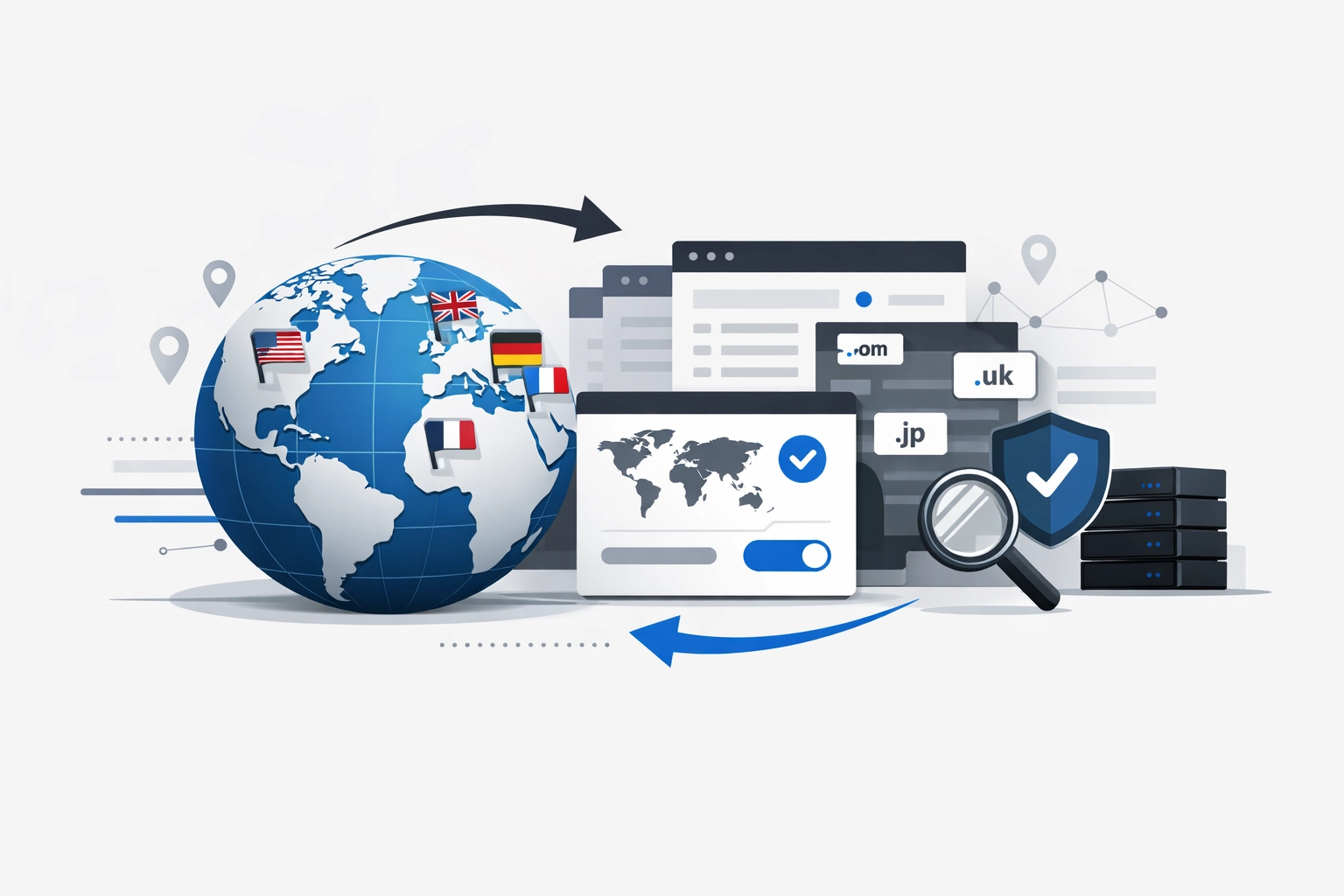
In a world where brands pursue global growth through local markets, the challenge isn’t merely list-building, but building a nuanced, country-aware inventory of domains. A robust website database by country helps teams plan localization, ensure brand consistency, and stay aligned with local regulatory expectations. The objective is to move beyond generic domain lists into a structured, governance-driven catalog that clearly ties each domain to its market, language, content strategy, and risk profile. This article outlines a practical approach to assembling such an inventory, with a focus on data provenance, validation, and actionable enrichment. It also highlights how RDAP (Registration Data Access Protocol) and trusted country datasets can anchor a resilient, scalable workflow. When you combine a country-aware inventory with disciplined data governance, you unlock faster localization, stronger brand protection, and clearer regulatory posture across markets. Note: the field of country-specific domain data is dynamic. For teams starting from scratch, consider a phased approach that grows from a core dataset into a full-fledged, company-wide domain catalog. (webatla.com)
Why a country-aware domain inventory matters
Many organizations rely on broad domain lists that mix generic top-level domains with country-code extensions. That approach can obscure critical differences between markets: which domains actually control a brand in a given country, which domains host localized content, and which are legitimate mirrors or potentially risky copies. A country-aware inventory answers questions like: Which domains are actively used in [Country X]? Is content aligned with local language preferences? Are there local registries or regulatory constraints that affect how we publish or gather data in that market?
Key benefits of a country-aware inventory include better localization readiness, improved risk management, and clearer investment decisions. Industry observers note that country-specific domain adoption patterns remain meaningful; for example, country-code TLDs (ccTLDs) continue to play a central role in many regional markets, even as global generic TLDs grow. In 2025–2026, analyses consistently show the United States leading in total domain registrations, with ccTLDs like .de and others maintaining strong local traction in their respective regions. This context underscores why a country-aware approach can yield measurable advantages for global brands. (hostingadvice.com)
For practitioners, the value extends beyond branding. A country-focused domain inventory supports localization workflows (e.g., language-targeted content, regional SEO, and local hosting considerations), as well as governance tasks such as copyright screening, privacy assessments, and regulatory mapping. The availability of structured country-level data—such as what a dataset like WebAtla’s Websites by Country dataset offers—gives teams a practical foundation to start building their inventory with credible provenance. This dataset is described by WebAtla as a global domain database that covers the world and provides structured domain information by country. (webatla.com)
A practical framework to build the inventory
Think of the inventory as a layered model that combines core domain facts with country attributes, brand context, and governance rules. The framework below is designed to be actionable, scalable, and defensible for both beginners and professionals. It centers on four interlocking layers and a repeatable workflow that keeps the catalog current and useful for localization and compliance decisions.
- Layer 1 — Data Layer (Domain metadata)
- Domain name, TLD, and secondary aliases
- Registrar, registration date, expiry date
- DNS records, IP mappings, SSL status
- Content language and target audience cues
- Layer 2 — Geography Layer (Country and region)
- Country of market focus (or multiple markets if multi-regional)
- Localized language/locale mapping
- Geographic hosting considerations and latency targets
- Layer 3 — Brand & Compliance Layer (Brand alignment and regulatory posture)
- Trademark status and potential conflicts
- Content strategy alignment with local laws (privacy, advertising, consumer rights)
- Policy on brand usage, redirection, and internationalization rules
- Layer 4 — Quality & Risk Layer (Data health and risk)
- Data freshness and verification cadence
- Risk indicators (suspicious ownership, geolocation ambiguity, or conflicting signals)
- Audit trail and governance approvals
This four-layer framework supports a robust inventory that is not only descriptive but also prescriptive: it guides localization decisions, informs brand-protection actions, and flags data-quality gaps for remediation. A practical advantage of this approach is that it scales: you can start with a core set of countries and domains and expand to cover more markets as needs evolve. For readers seeking an immediately actionable dataset to seed their work, WebAtla’s Websites by Country dataset can serve as a credible starting point and reference for country attribution. (webatla.com)
Data sources and reliability: where the data comes from
Building a country-aware domain inventory hinges on reliable data sources and clear attribution. Two pillars are central to this effort: the RDAP data model and credible country-domain datasets.
RDAP as the backbone of registration data. RDAP (Registration Data Access Protocol) provides a modern, machine-readable alternative to the legacy WHOIS protocol. It standardizes how registration information is queried and returned, typically in JSON, which simplifies enrichment, normalization, and automated governance workflows. RDAP is designed to improve data consistency and parsing, reducing ambiguity when mapping domains to markets and brands. The RDAP standard is defined in RFC 7482 and related RFCs, which describe the query format and the relationship to related registration data. (rfc-editor.org)
Industry discussions also emphasize that while RDAP improves data structure and accessibility, coverage is not universal. Many ccTLD operators have adopted RDAP to varying degrees, and some rely on older WHOIS or mixed approaches. Practitioners should anticipate gaps and implement validation strategies to handle instances where RDAP data is incomplete or unavailable for certain extensions. ICANN and technical community discussions outline these coverage realities and the ongoing evolution of RDAP rollout across registries. (archive.icann.org)
Beyond RDAP, credible country-specific datasets provide the essential country attribution layer for your inventory. The WebAtla dataset, described by the publisher as a global domain database with country-level structure, exemplifies the kind of source teams use to bootstrap country mapping and market focus. When combined with RDAP-enriched data, it creates a robust baseline for localization planning. See WebAtla’s “Websites by Country” dataset for context and structure. (webatla.com)
Understanding broader market context helps set expectations. Analyses and statistics about domain registrations by country show that countries continue to drive substantial portions of the global domain landscape, underscoring the importance of country-specific inventories for growth and risk management. For instance, recent industry overviews highlight the United States as a leading market in total registrations, with ccTLDs showing meaningful regional strength in places like Germany (.de) and beyond. This reinforces why a country-aware approach is strategically sound for global brands. (hostingadvice.com)
A practical workflow: how to build and maintain the inventory
Transforming the four-layer framework into a working workflow requires disciplined steps and governance. The following six-step workflow is designed to be implementable with existing datasets and data-provenance practices, while leaving room for bespoke enrichment tailored to your organization.
- Step 1 — Assemble baseline domain lists
- Pull initial domain lists from credible country datasets and registries, prioritizing domains with active presence in target markets.
- Flag domains with unclear market attribution or ambiguous language signals for deeper review.
- Step 2 — Normalize to a common schema
- Adopt a consistent set of fields (domain, TLD, country, language, registrar, expiry, DNS status, hosting region) and map aliases to canonical entries.
- Resolve variations (e.g., punycode, IDNs) into a uniform representation.
3 Step 3 — Enrich with country and brand context
- Attach country attribution and language targets to each domain entry.
- Cross-check trademark status and potential conflicts through internal brand governance workflows or external brand clearance tools.
4 Step 4 — Validate data quality
- Run periodic checks against RDAP/WHOIS sources to verify ownership, registration dates, and expiry windows.
- Sample a subset of domains to confirm content relevance to the country market (language, geo-targeting, and hosting locality).
5 Step 5 — Enrich with operational context
- Annotate domains with internal notes on localization status (translation readiness, local SEO signals, and content suitability).
- Document regulatory considerations (privacy laws, consumer rights, advertising rules) applicable to each market.
6 Step 6 — Establish governance and refresh cadence
- Define ownership for each country segment and set a regular refresh cadence (e.g., quarterly checks for high-priority markets, biannual for others).
- Provide an audit trail that records changes, approvals, and data sources used for enrichment.
Integrating the client’s capabilities can streamline this workflow. For teams seeking a credible data backbone for RDAP and WHOIS data, the RDAP & WHOIS Database page provides a practical resource, while the Websites by Country dataset offers a country-structured starting point for attribution. These resources illustrate how real-world data products underpin a country-focused domain catalog. (webatla.com)
Expert insight and common pitfalls
Expert insight: A data governance practitioner notes that standardizing country attribution across TLDs reduces duplication and misalignment, enabling clearer localization decisions and more reliable risk profiling. In practice, this means mapping country signals consistently—not just at the domain level, but across the entire inventory, including subdomains, redirects, and brand-owned assets. RDAP’s JSON-based data model can support this harmonization when you implement a disciplined normalization process that accounts for variations in how registrants and territories are represented across registries. (rfc-editor.org)
Limitations and common mistakes are worth calling out up front. First, relying on a single data source—even a credible one—leads to blind spots. A robust approach uses multiple signals (RDAP, WHOIS when available, country-specific registries, and brand governance inputs). Second, assuming that the registrant’s country equals the market where a domain is active or intended to be used can be misleading; many brands maintain multi-market domains with centralized ownership. Third, ignoring the existence of country-brand TLDs, geo-targeted content, and language-specific landing pages can undermine localization initiatives. Finally, RDAP coverage is not universal; several ccTLDs still rely on older Whois mechanisms or provide incomplete data, so you’ll need explicit validation and fallback processes. See RDAP documentation and practical rollout notes for context. (archive.icann.org)
A practical example: how this approach informs localization strategy
Consider a hypothetical consumer electronics brand expanding into three markets: Germany, the United States, and Japan. A country-aware inventory would map the following: the primary domain and any country-specific variants; which domains host localized product pages; the content language and locale for each domain; and the corresponding regulatory considerations (e.g., consumer privacy expectations and advertising rules in the EU vs. the US vs. Japan). Such a catalog would enable the localization team to target landing pages with precise language signals, coordinate with regional marketing for local campaigns, and align with brand governance to minimize legal risk. At the same time, it would reveal gaps—domains that have drifted from branding or that no longer serve a market—prompting remediation actions and better budgeting for market entry or retirement of assets. This is precisely the kind of insight that a credible country-focused dataset can unlock, when combined with a robust RDAP-based data layer. (hostingadvice.com)
Limitations and mistakes in practice: a quick checklist
- Relying on one source for attribution. Use multiple signals (RDAP, WHOIS when available, country registries) to triangulate country-market mappings.
- Assuming registrant country equals market. Some brands own domains in many markets but publish content only in a subset of those markets; map actual landing pages and language signals rather than ownership alone.
- Ignoring non-TLD assets and brand abbreviations. Subdomains, brand-owned microsites, and brand shorthand can affect localization reach and risk profiles.
- Underinvesting in data refresh. Domain data changes frequently; a quarterly cadence may be insufficient for fast-moving markets or high-risk brands.
- Overreliance on RDAP without fallback. Not all registries expose RDAP data; establish fallback procedures and manual checks for gaps. (archive.icann.org)
Conclusion: turning data into informed action across borders
A country-aware domain inventory is more than a catalog—it is a strategic asset that informs localization strategies, brand protection initiatives, and regulatory compliance planning. By combining a clear data model with a disciplined workflow and credible data sources (notably RDAP and country datasets such as WebAtla’s), teams can build a living inventory that scales with global growth while reducing risk. The practical steps outlined here—defining data and geography layers, embedding brand and compliance context, and instituting regular validation—provide a solid path from country signals to concrete localization actions. For organizations seeking a credible data backbone, adopting a robust RDAP/WHOIS data approach and integrating country-structured datasets can unlock faster, safer expansion while preserving brand integrity. The ecosystem around country data continues to evolve, but the core discipline remains constant: trust the data, validate relentlessly, and govern your inventory with clear ownership.
Internal and external resources
If you’re evaluating data sources, consider starting with WebAtla’s country-focused dataset as a baseline for country attribution, complemented by RDAP-enabled data sources for registration details. For more on RDAP’s design and rollout, see the RFC 7482 — RDAP Query Format and related ICANN-discussed rollout notes. (rfc-editor.org)
For broader context on country-domain dynamics and market share by country, industry references discuss the continued relevance of ccTLDs and the U.S. market’s leadership in total registrations. These trends support the value of a country-aware inventory for localization and growth planning. (hostingadvice.com)
Client resources referenced in this article: