Domain Intelligence by Design: Why a Domains Database Matters for Product Strategy
In crowded markets, brands compete not only over physical shelves or online ads but over the digital perimeters surrounding a name. The right collection of domains — a well-governed domains database — can illuminate growth opportunities, reveal competitive moves, and signal where a product roadmap should go next. This is not merely a brand-protection exercise; it’s a structured approach to market intelligence. When teams treat domains as data signals rather than a checkbox of legal risk, they unlock a systematic way to prioritize investments, curb risk, and accelerate go-to-market decisions. This article presents a practical, designerly way to assemble and use a domains database as a core element of product strategy. Throughout, we reference best-practices and evolving data standards (noting that the industry is transitioning from WHOIS to RDAP, with implications for data access and quality). (icann.org)
The Domain Intelligence Framework: From Inventory to Action
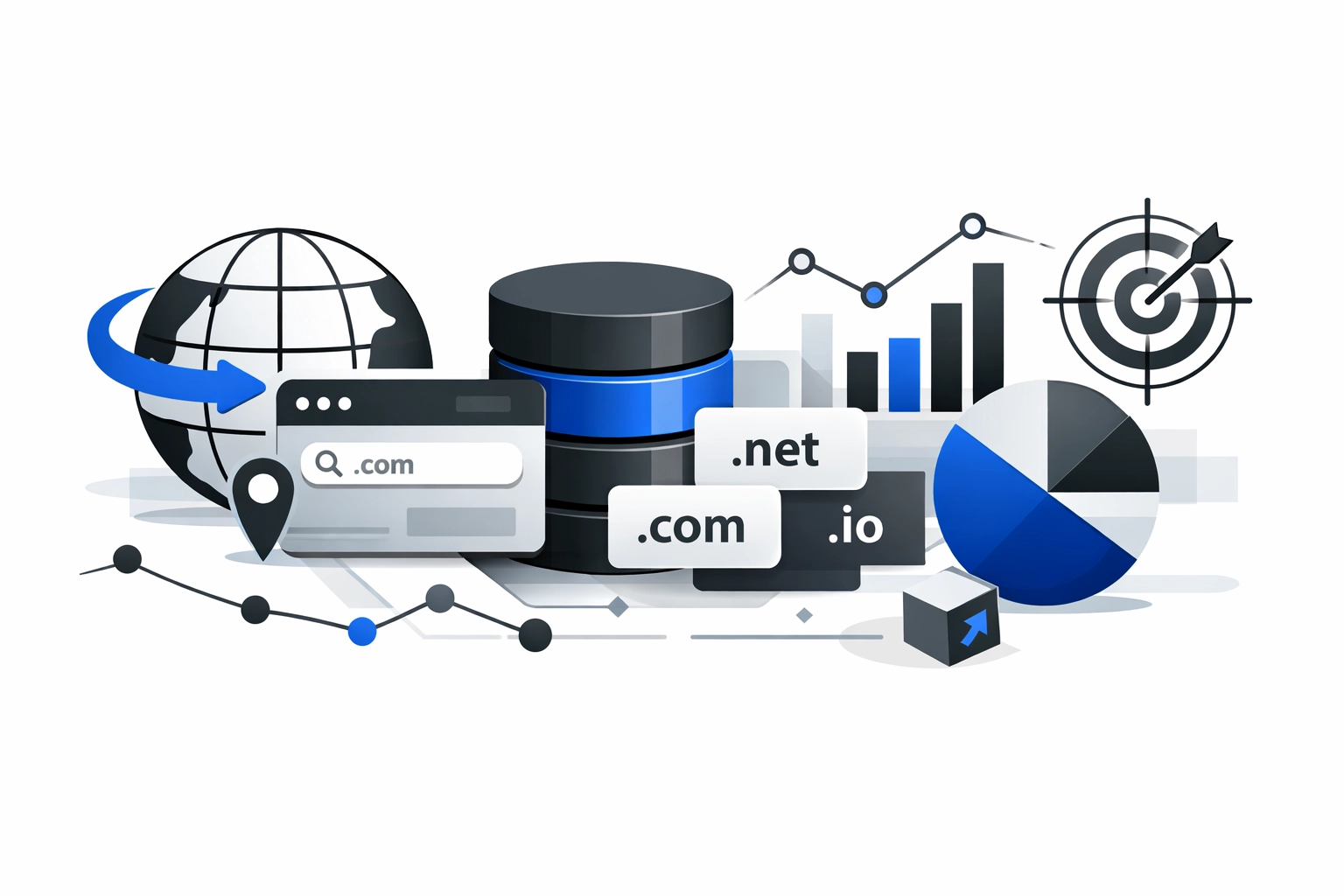
Think of a domains database as a living map: it records not just which domains exist, but who owns them, which TLDs are active, and how those signals align with your product and geographic strategy. The framework below is designed to be pragmatic for both startups and established brands seeking disciplined domain governance and strategic insight.
- Step 1 — Domain Inventory: Build a compact, normalized catalog of domains relevant to your brand and market. Include core fields such as domain name, primary owner, registration status, creation date, last seen, and a short note on strategic relevance (brand protection, potential expansion, or competitive signal). This step provides the backbone for all subsequent analysis and can leverage RDAP/WHOIS data as the data source, noting that RDAP is increasingly the standard for domain data across registries. ICANN has documented the shift toward RDAP as a replacement for WHOIS, which informs how you structure, ingest, and unify domain data going forward. (icann.org)
- Step 2 — Cross-TLD Mapping: Extend the inventory across a curated set of TLDs and geographies that matter for your growth plan (for example, common generic TLDs like .com and strategic country or brand TLDs). This enables you to see patterns such as duplicates or near-duplicates across markets, which can indicate brand expansion opportunities or risk clusters. Data sources for this mapping include publicly listed domain catalogs and your own internal registrant data. For teams examining a broad digital footprint, a centralized reference like a domains database helps avoid ad-hoc checks and scattered notes. See how providers organize domain lists by TLDs to support this work. (medium.com)
- Step 3 — Market Signals from Ownership Patterns: Analyze who owns similar domains across multiple TLDs, whether there are gaps in coverage, and where competitors are expanding. Ownership parity across geographies can reveal where consumer interest is likely to grow or where a brand should defensively secure a presence. While domain data is a powerful signal, it is not a substitute for user research or market surveys; treat it as one of several inputs in product planning. Contemporary industry commentary emphasizes that RDAP/WHOIS data is evolving, with standardization and structured formats improving data usability. (domaintools.com)
- Step 4 — Governance and Hygiene: Establish policies for ongoing domain monitoring, renewal tracking, and lifecycle management. Regular audits prevent dangerous gaps where a missing domain could become an acquisition or impersonation risk. As brand protection continues to evolve, best practices emphasize proactive domains hygiene rather than reactive defense. For organizations investing in global brand protection, this is a natural extension of a domains database into risk governance. (gcd.com)
- Step 5 — Actionable Outcomes: Translate signals into concrete strategy: product roadmaps, pricing plans for new offerings, or risk-mitigation steps. Use the database to inform decisions such as which TLDs to secure for a new product line, whether to pursue a regional expansion, or where to focus localization efforts. The goal is to convert data into decisions, not to collect information for its own sake. A disciplined workflow is essential; otherwise the database risks becoming a stale repository rather than a decision-enabling asset. (gcd.com)
From Data to Decisions: How a Domains Database Guides Product Strategy
A well-structured domains database does more than guard your brand. It acts as a predictive signal for product-market fit and a lens into competitive dynamics. Here are concrete ways teams can use the database to shape strategy.
- Signal-based feature planning: If you observe unowned but highly intuitive domain variants tied to a product concept (for example, a brand-name + regional extension), you can estimate demand signals or potential regional interest. Use this insight to prioritize feature localization, packaging variants, or go-to-market partnerships in specific markets.
- Geography-driven roadmap: Cross-TLD coverage can reveal where consumer interest exists but where a branded presence is incomplete. Align product localization, pricing experiments, and channel partnerships with those signals, reducing market-entry risk and increasing velocity. The broader domain-data ecosystem increasingly supports these analyses through standardized data formats (RDAP) and centralized databases. (icann.org)
- Competitive intelligence without leaks: Monitoring adjacent domains owned by competitors or by related brands can highlight potential white-label opportunities, rebranding moves, or ancillary markets that competitors may be courting. This is a legitimate competitive signal when used alongside other market intel, not as a sole predictor. Market-thinking resources emphasize balancing proactive protection with opportunistic expansion. (domaintools.com)
- Implications for pricing and packaging: Domain signals can imply consumer intent around product naming, feature scope, or branding. If a new service concept aligns with several domain variants in multiple markets, you may have a ready-made symbolic map for product naming, even before user testing begins. Just be mindful that domain signals are one of many inputs guiding pricing and packaging decisions. (domaintools.com)
Tools and Data Sources: Where to Build the Domains Database
Assembling a robust domains database requires reliable data streams and a governance process. The modern data landscape favors standardized, machine-readable signals. RDAP, the Registration Data Access Protocol, provides a modern alternative to the legacy WHOIS, offering structured JSON responses and greater scalability for automated workflows. ICANN has documented the transition and the rationale behind RDAP as a replacement for WHOIS, which matters for the way you ingest, normalize, and interpret domain data. (icann.org)
In practical terms, teams can rely on public domain catalogs and registrar-provided data, but to operationalize the domains database at scale, a centralized data feed or database is invaluable. A few proven approaches include:
- Assemble core domain fields (domain, owner, status, dates, and notes) and maintain a change-log to capture ownership or status shifts.
- Map domains by TLDs and geographies that align with your growth goals.
- Incorporate data stewardship practices to ensure accuracy, timeliness, and privacy where applicable.
- Use automated checks to flag expiring domains, potential impersonation, and newly registered variants around key names.
For teams looking to operationalize this work, WebAtla offers a suite of tools that can centralize domain signals and streamline data normalization. In particular, their RDAP and WHOIS database provides unified, structured data feeds that facilitate scalable analysis, and their catalog of domains by TLDs helps teams scope coverage efficiently. For those who want to explore concrete sources and pricing, see the WebAtla RDAP & WHOIS database and the company’s list-by-TLD resources. RDAP & WHOIS Database · List of domains by TLDs · Pricing. (medium.com)
A Practical Case: How a Mid-Sized Brand Used a Domains Database to Shape Its Roadmap
Consider a hypothetical consumer electronics company launching a new product line. The team starts with a compact domains inventory focused on the brand name plus key product concepts and regional targets. By mapping these domains across multiple TLDs and geographies, they quickly identify:
- Unowned but highly intuitive variants that could be used for a regional sub-brand or feature naming.
- Several domains registered by competitors that hint at planned regional expansions, enabling proactive market entry planning.
- Gaps in certain markets where a brand-appropriate domain could support localized campaigns and regional e-commerce experiences.
Armed with these signals, the product team revises the feature roadmap, prioritizing features that resonate with regional naming patterns and planning localized packaging. The marketing team aligns domain-backed signals with local campaigns, while the risk-management function tracks impersonation risk across high-value domains. The result is a more coherent, data-informed path from concept to market, with domain signals acting as a check against blind spots. For teams evaluating similar opportunities, the practice is to pair domain signals with user research and competitive intelligence, rather than relying on domain data alone. (domaintools.com)
Limitations and Common Mistakes: What Domain Signals Can’t Do (And How to Avoid Pitfalls)
Like any data source, a domains database has limitations. Here are the most common missteps and how to mitigate them.
- Over-reliance on domain ownership as a market signal: Owning a domain does not guarantee customer interest or market success. Treat ownership patterns as one signal among many — product-market fit requires user research, competitor analysis, and pilot deployments. The industry consensus is clear that domain data should complement, not replace, direct market feedback. (domaintools.com)
- Underestimating data quality and latency: RDAP and WHOIS data are improving, but data quality can vary by registry and geography. Some regions are still transitioning, and data can be delayed or incomplete, so verification with other data sources is essential. ICANN’s RDAP transition material and subsequent industry analyses highlight these caveats as data ecosystems mature. (icann.org)
- Privacy and redaction considerations: Personal data in domain records is subject to privacy protections, and some registries redact information in RDAP/WHOIS responses. This can complicate ownership attribution and risk assessment, particularly for impersonation safeguards. Understanding these privacy dynamics helps teams design checks that are robust even when data is partially obscured. (en.wikipedia.org)
- Fragmented tooling and inconsistent schemas: As RDAP becomes the standard, different registries may expose fields in slightly different ways. Normalization to a common schema is critical for reliable analytics and scalable workflows. Industry practitioners note the value of normalized RDAP responses for dashboards and automation. (domaintools.com)
Implementation Checklist: Turning a Concept into an Operational Domain Intelligence System
- Define scope and governance: Decide which markets, brands, and product concepts the database will cover, and assign ownership for data stewardship.
- Choose data sources and formats: Start with RDAP where available, and layer in supplementary data (e.g., brand catalogs or internal registrant data) to fill gaps.
- Standardize fields and naming conventions: Create a data dictionary to ensure consistency across TLDs and geographies.
- Automate monitoring and alerts: Set up renewal reminders, impersonation checks, and new-domain alerts tied to key brand terms and product ideas.
- Integrate with decision workflows: Build clear handoffs to product, marketing, and risk teams, with regular review cadences.
- Iterate and learn: Periodically reassess the relevance of signals, refine the scoring of opportunities, and prune stale data.
For teams seeking a scalable, credible source of domain signals, WebAtla’s RDAP-based approach and catalog of domain lists by TLDs can support the technical backbone of a domains database. See their RDAP/WHS data offering and TLD catalogs for practical reference and procurement considerations. RDAP & WHOIS Database · List of domains by TLDs · Pricing. (medium.com)
Expert Insight and a Practical Limitation
Expert insight: A domains database should be treated as a strategic asset that closes the loop between brand governance and product planning. By tying domain signals to concrete decision-making workflows (roadmaps, regional launches, naming decisions), teams reduce time-to-market and minimize misalignment between brand, product, and go-to-market plans. A disciplined approach also helps you anticipate impersonation risk in advance, which is especially valuable in markets with aggressive counterfeiting dynamics. This perspective aligns with current brand-protection discussions that emphasize proactive domain coverage and governance as part of overall risk management. Go-to-market alignment with domain signals is exactly where product strategy and domain hygiene intersect. (gcd.com)
Limitation/mistake to avoid: conflating domain signals with customer demand. Domain signals may point to interest or intent, but they do not guarantee demand, and they can be noisy if the data is not triangulated with user research, tests, and actual market feedback. The literature around RDAP/WHOIS data quality also notes inconsistencies and transition-related gaps, so teams should design checks and validation steps before acting on this data alone. (domaintools.com)
Conclusion: The Domain Database as a Strategic Compass
Building a domains database is not a vanity exercise; it is a disciplined way to collect signals that complements traditional market research and competitive intelligence. When designed with strong governance, standardized data formats, and clear decision workflows, a domains database becomes a proactive tool for product strategy, brand protection, and growth planning. It helps teams identify where to invest in new domain coverage, where to defend against impersonation, and where to align product roadmaps with market signals. As the industry continues to evolve toward RDAP-based data ecosystems, the ability to normalize, query, and act on domain data will only become more crucial for teams aiming to stay ahead in a fast-moving digital economy. For organizations ready to explore this approach, starting with a centralized, scalable source of domain signals — such as an RDAP-enabled database — can be a transformative step. RDAP & WHOIS Database is one avenue to begin, with broader domain catalogs (by TLD) to guide geographic and product expansion.